
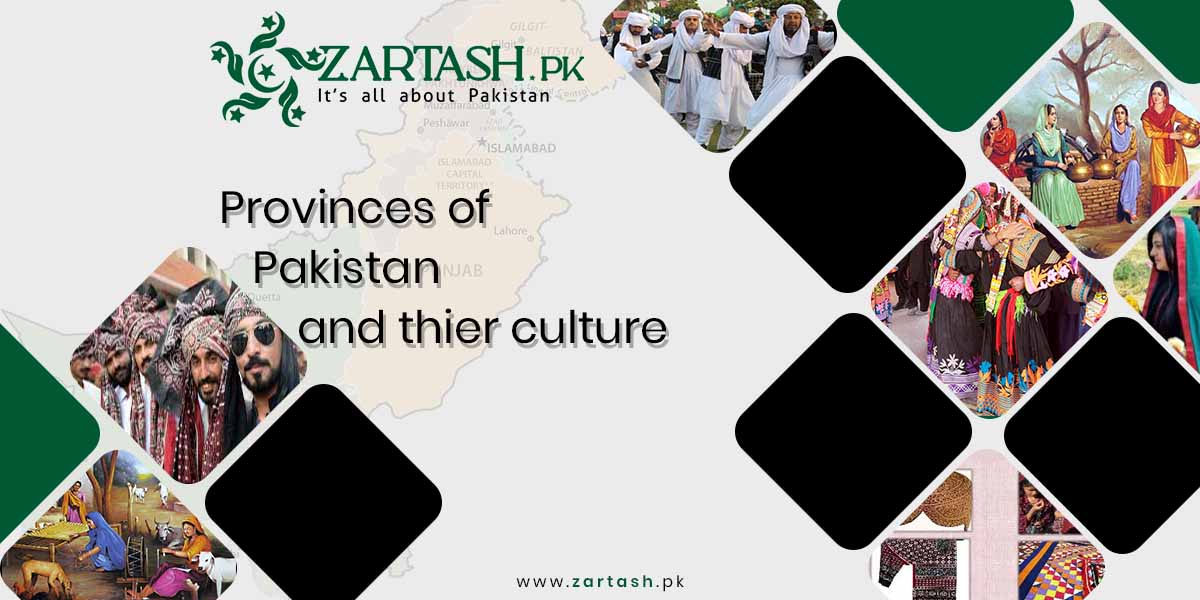
Pakistan has four provinces, Punjab, Sindh, Khyber Pakhtunkhwa and Balochistan, plus the Islamabad Capital Territory and two administrative territories, Azad Jammu and Kashmir and Gilgit-Baltistan. Each province carries its own language, dress, cuisine and festival calendar.
The distinction matters because search results and school notes mix the categories constantly. A province has a governor, a chief minister, an elected provincial assembly and seats in the Senate under Article 1 of the Constitution. Islamabad Capital Territory is federal ground administered from the centre. Azad Jammu and Kashmir has its own constitution, president and legislative assembly but is not a province, and Gilgit-Baltistan is administered from Islamabad and has no provincial status. That is why “four provinces of Pakistan” and “five provinces of Pakistan” both return results, and only the first is correct.
This article gives the capital, area, 2023 census population and cultural profile of every province and territory, covering language, dress, food, festivals and notable places. All population figures come from the 2023 digital census published by the Pakistan Bureau of Statistics.
What Are the Four Provinces of Pakistan?
The four provinces of Pakistan are Punjab, Sindh, Khyber Pakhtunkhwa and Balochistan. Together with the Islamabad Capital Territory they cover 796,095 square kilometres and held 241,499,431 people at the 2023 census. The table below sets them beside the two administrative territories so the difference in status is visible.
| Province or territory | Capital | Area (sq km) | Population (2023 census) | Main languages | Known for |
|---|---|---|---|---|---|
| Punjab (province) | Lahore | 205,344 | 127,688,922 | Punjabi, Saraiki, Urdu, Pothwari | Wheat and cotton farming, Mughal Lahore, bhangra |
| Sindh (province) | Karachi | 140,914 | 55,696,147 | Sindhi, Urdu, Punjabi, Pashto | Indus Valley sites, Sufi shrines, ajrak and topi |
| Khyber Pakhtunkhwa (province) | Peshawar | 101,741 | 40,856,097 | Pashto, Hindko, Khowar, Saraiki | Gandhara ruins, attan dance, chapli kebab |
| Balochistan (province) | Quetta | 347,190 | 14,894,402 | Balochi, Pashto, Brahui, Sindhi | Gwadar port, sajji, Balochi embroidery, dry fruit |
| Islamabad Capital Territory (federal territory) | Islamabad | 906 | 2,363,863 | Urdu, Punjabi, Pothwari | Federal capital, Faisal Mosque, Margalla Hills |
| Azad Jammu and Kashmir (administrative territory) | Muzaffarabad | 13,297 | 4,333,467 | Pahari, Gojri, Kashmiri | Neelum valley, its own constitution and assembly |
| Gilgit-Baltistan (administrative territory) | Gilgit | 72,496 | 1,709,049 | Shina, Balti, Burushaski, Khowar | K2 and the Karakoram, Hunza, Shandur polo |
The 241,499,431 total is what the Council of Common Interests approved in August 2023 for the four provinces and Islamabad, and it is the base for seat allocation and revenue shares. Azad Jammu and Kashmir and Gilgit-Baltistan were counted separately, bringing the all-areas total to 247,541,947. National literacy in the same census was 60.7 per cent.
Which Is the Smallest Province of Pakistan by Area?
Khyber Pakhtunkhwa is the smallest province of Pakistan by area at 101,741 square kilometres, which is 12.8 per cent of the country outside the territories. Balochistan is the largest by area at 347,190 square kilometres, or 43.6 per cent, and it is also the smallest by population.
The four superlative answers people search for do not line up with each other, which is the reason the question keeps being asked in different forms.
- Largest by area: Balochistan, 347,190 sq km, covering 43.6 per cent of the four provinces and Islamabad combined.
- Smallest by area: Khyber Pakhtunkhwa, 101,741 sq km. This figure already includes the seven tribal districts merged into the province in 2018, so no separate FATA area needs to be added to it.
- Largest by population: Punjab, 127,688,922 people, or 52.9 per cent of the census total. More than half of Pakistan lives in one province.
- Smallest by population: Balochistan, 14,894,402 people, or 6.2 per cent, at a density of about 43 people per square kilometre against 622 in Punjab.
Islamabad Capital Territory is smaller than any province on both counts, at 906 square kilometres and 2,363,863 people, but it is a federal territory rather than a province, so it does not answer the smallest-province question.
What Are the Territories of Pakistan?
Pakistan has three units that are not provinces: Islamabad Capital Territory, Azad Jammu and Kashmir, and Gilgit-Baltistan. The two Kashmir-linked territories are governed under arrangements tied to the unresolved status of the former princely state of Jammu and Kashmir.
Islamabad Capital Territory was carved out of Rawalpindi district in the 1960s when the capital moved from Karachi. It is administered by the federal government through a chief commissioner and contains Islamabad city and a rural belt running up to the Margalla Hills.
Azad Jammu and Kashmir has its own interim constitution of 1974, its own president, prime minister, legislative assembly and supreme court. Its capital is Muzaffarabad and it covers 13,297 square kilometres across ten districts, with defence, currency and foreign affairs left to Islamabad.
Gilgit-Baltistan covers 72,496 square kilometres, more than five times the area of Azad Jammu and Kashmir, and holds about 1.7 million people across ten districts. It has an elected assembly under the Gilgit-Baltistan Order of 2018 but no representation in the National Assembly or Senate and no mention in Article 1 of the Constitution. Successive governments, including Imran Khan’s in 2020, have promised provisional provincial status, and that promise is where the phrase “fifth province of Pakistan” comes from. As of 2026 no constitutional amendment has been passed, so the correct answer remains four provinces.
Punjab Province and Punjabi Culture
Punjab is the most populous province of Pakistan and the second largest by area, occupying the Indus plain between the Jhelum and the Sutlej. The name means land of five rivers. Lahore is the capital, the province holds 127,688,922 people across 41 districts in 10 divisions, its 2023 literacy rate of 66.3 per cent is the highest of the four provinces, and it produces the bulk of Pakistan’s wheat, rice, cotton and sugarcane.
Language, Dress and Daily Life in Punjab
Punjabi is the mother tongue of most of the province, with Saraiki dominant in the south around Multan, Bahawalpur and Dera Ghazi Khan, and Pothwari spoken in the Rawalpindi and Jhelum belt. Urdu serves as the language of schooling and administration across all of it. The full national breakdown, including why the Punjabi share is quoted as both 37 and 60 per cent, is set out in the article on the languages of Pakistan and their speaker percentages.
Everyday dress is the shalwar kameez, worn with a dupatta by women and often with a turban or a chadar by rural men. The kurta and tehmat, a wrapped lower garment, is still standard among farmers and at folk performances. Phulkari embroidery and khussa leather footwear from Multan and Bahawalpur are the province’s best known dress crafts, alongside the cobalt-glazed blue pottery made in Multan.
Punjabi Food and Festivals
Punjabi cooking is wheat-based and dairy-heavy. Saag with makai roti, nihari, paya, halwa puri, Lahori chargha and tandoori naan are the dishes most associated with the province, and lassi is drunk with meals rather than after them. Multan supplies sohan halwa and Bahawalpur its dates.
Bhangra, luddi, jhumar and sammi are the folk dances, performed to the dhol. The festival calendar centres on Sufi urs gatherings: Mela Chiraghan, the festival of lights at the shrine of Shah Hussain in Baghbanpura next to the Shalimar Gardens, runs three days each spring, and the urs of Data Ganj Bakhsh in Lahore and Baba Farid in Pakpattan are larger still. Basant, the spring kite festival, was banned across Punjab in 2005 after deaths caused by metal-coated kite string, and the Punjab Assembly replaced the ban with a licensing system through the Punjab Regulation of Kite Flying Act 2025, under which Basant returned to Lahore district on 6 to 8 February 2026 as a licensed event with conditions on string, kite size and location while keeping kite flying illegal outside sanctioned dates and venues.
Notable Places in Punjab
Punjab holds four of Pakistan’s six UNESCO World Heritage Sites: Taxila, the Lahore Fort and Shalamar Gardens as a joint listing, and Rohtas Fort near Jhelum. Harappa in Sahiwal district is the type site of the Indus Valley civilisation and gives the Harappan period its name. Derawar Fort stands in the Cholistan desert south of Bahawalpur, and Katas Raj in the Salt Range is a Hindu temple complex still used for pilgrimage.
Sindh Province and Sindhi Culture
Sindh is the second most populous province and the third largest by area, running along the lower Indus from Kashmore to the Arabian Sea. Karachi is both the capital and the largest city in Pakistan. The province holds 55,696,147 people across 30 districts in 6 divisions at a literacy rate of 57.5 per cent, and the gap between Karachi and the interior districts is the widest urban to rural literacy gap in the country.
Language, Dress and Daily Life in Sindh
Sindhi is the provincial language and one of the oldest written languages in the region, with its own Perso-Arabic script of 52 letters. Urdu is the first language of much of urban Karachi and Hyderabad, and Punjabi, Pashto, Balochi, Brahui and Gujarati communities are all long settled in the province.
The two identity markers of Sindhi dress are the ajrak and the Sindhi topi. Ajrak is a block-printed cotton shawl in madder red and indigo, printed in Bhit Shah, Matiari and Hala using a resist process that takes more than a dozen stages. The Sindhi topi is a rigid embroidered cap left open at the front. Both are worn together on Sindhi Culture Day, held on the first Sunday of December.
Sindhi Food and Festivals
Sindhi biryani, sai bhaji, koki, and palla fish taken from the Indus are the province’s signature dishes. Sindhi cooking uses less chilli than Punjabi cooking in the north of the province and considerably more in the south around Thar.
The festival calendar is built on Sufi shrines. The urs of Shah Abdul Latif Bhittai at Bhit Shah, of Sachal Sarmast at Daraza near Khairpur, and of Lal Shahbaz Qalandar at Sehwan Sharif each fill their towns for several days, and the dhamaal drumming at Sehwan is the best known devotional performance in Pakistan. Sindhi folk sports include malakhro wrestling and wanjh wati.
Notable Places in Sindh
Mohenjo-daro in Larkana district is the largest surviving Indus Valley city and was inscribed by UNESCO in 1980. The Makli necropolis at Thatta, inscribed in 1981, is one of the largest funerary sites in the world. Ranikot Fort in Jamshoro district has the longest wall of any fortification in the world, and the Thar desert supports a distinct Rajasthani-influenced culture of its own.
Khyber Pakhtunkhwa and Pashtun Culture
Khyber Pakhtunkhwa is the third most populous province and the smallest of the four by area, running along the Afghan border from Chitral in the north to Dera Ismail Khan in the south, with Peshawar as its capital. The province holds 40,856,097 people at a literacy rate of 51 per cent. It was called the North West Frontier Province until 2010, when the Eighteenth Amendment renamed it.
The Twenty-fifth Amendment merged the Federally Administered Tribal Areas into the province in 2018. Seven tribal districts, Bajaur, Khyber, Kurram, Mohmand, North Waziristan, Orakzai and South Waziristan, joined Khyber Pakhtunkhwa, which is why the area figure of 101,741 square kilometres is larger than the pre-2018 one and why FATA no longer exists as a separate unit. The province is now organised into 7 divisions and, depending on the date of the list, 38 to 40 districts; Pakistani sources disagree because new districts are still being notified.
Language, Dress and Daily Life in Khyber Pakhtunkhwa
Pashto is the language of most of the province. Hindko is spoken in Hazara around Abbottabad and Mansehra and in parts of old Peshawar city, Khowar in Chitral, Kohistani in the upper Indus valleys, and Saraiki in the south around Dera Ismail Khan. The Kalash valleys of Chitral hold a small non-Muslim community with its own language and religion.
Men wear the shalwar kameez with a waistcoat and either a pakol, the flat rolled woollen cap of the north, or a turban. Women’s dress varies sharply between Hazara, the settled Peshawar valley and the tribal districts. Social organisation follows Pashtunwali, an unwritten code covering hospitality, sanctuary and revenge, and disputes are still settled by jirga, a council of elders deciding by consensus.
Food, Festivals and Notable Places in Khyber Pakhtunkhwa
The cooking is meat-forward and lightly spiced. Chapli kebab from Peshawar, namkeen karahi cooked with salt and tomato alone, kabuli pulao and lamb roasted over stone are the dishes the province is known for, and green tea is served in place of milk tea.
Attan, danced in a widening circle to a dhol, is the main Pashtun folk dance, with the Khattak dance performed with swords as its martial variant. Pashtun Culture Day has been marked on 23 September since 2014. The Shandur Polo Festival is played each July on the Shandur pass at about 3,700 metres between teams from Chitral and Gilgit, and the Kalash festivals of Chilam Joshi in May, Uchal in August and Chaumos in December run on their own calendar.
Takht-i-Bahi in Mardan district, a Buddhist monastery complex inscribed by UNESCO in 1980, is the province’s World Heritage Site. The wider Gandhara region produced the Greco-Buddhist sculpture now held in the Peshawar Museum, and Swat, Kaghan, Naran and Kalam carry most of the province’s tourism.
Balochistan Province and Baloch Culture
Balochistan is the largest province of Pakistan by area and the smallest by population, covering the arid plateau and coastal Makran belt in the south west. Quetta is the capital. The province holds 14,894,402 people across 10 divisions and, on current lists, 36 to 40 districts, at a density of about 43 people per square kilometre, and its literacy rate of 42 per cent is the lowest in the country. Balochistan borders Iran and Afghanistan and fronts the Arabian Sea, which is the basis of the geographical importance of Pakistan in regional trade routes.
Language, Dress and Daily Life in Balochistan
Balochi is the language of the south and west, Pashto of the north around Quetta, Zhob and Pishin, and Brahui of the central belt around Kalat. Brahui is a Dravidian language, unrelated to the Indo-Iranian languages around it, and it is the only Dravidian language spoken this far north west. Sindhi and Saraiki are spoken along the eastern border.
Baloch dress is the most heavily embroidered in Pakistan. Women wear a long frock with a broad embroidered front panel and pocket, called pashk, over loose shalwar, with the needlework known as doch; a single frock can take months. Men wear a loose shalwar kameez with a turban called a pag. Society is organised around tribes, with the Bugti, Marri, Mengal, Rind and Bizenjo among the largest.
Food, Festivals and Notable Places in Balochistan
Sajji, a whole lamb or chicken salted, skewered and roasted beside a fire, is the dish most identified with the province, served with kaak bread baked around a hot stone. Landhi, mutton dried through the winter, and khaddi kebab are the other staples. Balochistan supplies most of Pakistan’s apples, grapes, almonds and dates, and the date orchards of Panjgur and Turbat are the largest.
Baloch Culture Day is observed on 2 March with music, dance and displays of doch embroidery. The Sibi Mela, a horse and cattle show held in February, is the province’s oldest recurring fair. Chaap and do-chapi are the folk dances, performed to the sorud and the dhol.
Balochistan has no UNESCO World Heritage Site, but Mehrgarh in Kachhi district is one of the earliest known farming settlements in South Asia, occupied from around 7000 BCE and predating the Indus Valley cities. Hingol National Park on the Makran coast is the largest national park in Pakistan and contains the Princess of Hope rock formation, the Quaid-e-Azam Residency at Ziarat sits among the oldest juniper forests in the world, and Gwadar deep-sea port anchors the China-Pakistan Economic Corridor.
Frequently Asked Questions About the Provinces of Pakistan
How many provinces does Pakistan have?
Pakistan has four provinces: Punjab, Sindh, Khyber Pakhtunkhwa and Balochistan. It also has the Islamabad Capital Territory and two administrative territories, Azad Jammu and Kashmir and Gilgit-Baltistan, which are not provinces.
Which is the largest province of Pakistan by area?
Balochistan, at 347,190 square kilometres. That is 43.6 per cent of the land area of the four provinces and Islamabad combined, yet Balochistan holds only 6.2 per cent of the census population.
Which is the smallest province of Pakistan by area?
Khyber Pakhtunkhwa, at 101,741 square kilometres. That figure already includes the seven tribal districts merged into the province in 2018, so the former FATA area should not be added to it.
Which province has the largest population?
Punjab, with 127,688,922 people at the 2023 census. That is 52.9 per cent of the 241,499,431 counted in the four provinces and Islamabad, so more than half of Pakistan lives in Punjab.
Is Gilgit-Baltistan a province of Pakistan?
No. Gilgit-Baltistan is an administrative territory with an elected assembly but no seats in the National Assembly or Senate and no mention in Article 1 of the Constitution. Provisional provincial status has been promised but never legislated.
Last Thoughts on the Provinces of Pakistan
The four provinces of Pakistan are unequal in almost every measurable way. Punjab holds more than half the population on a quarter of the land. Balochistan holds nearly half the land and one person in sixteen. Khyber Pakhtunkhwa is the smallest by area yet grew by more than five million people between the 2017 and 2023 censuses. Sindh contains both the largest city in the country and some of its lowest rural literacy.
Culture tracks that geography rather than the provincial boundaries themselves. Saraiki southern Punjab has more in common with upper Sindh than with Lahore, Hazara speaks Hindko rather than Pashto, and Brahui in central Balochistan belongs to a language family found nowhere else nearby. The four-province map is an administrative frame, and the languages, dress and food inside it cross every line on it.
