
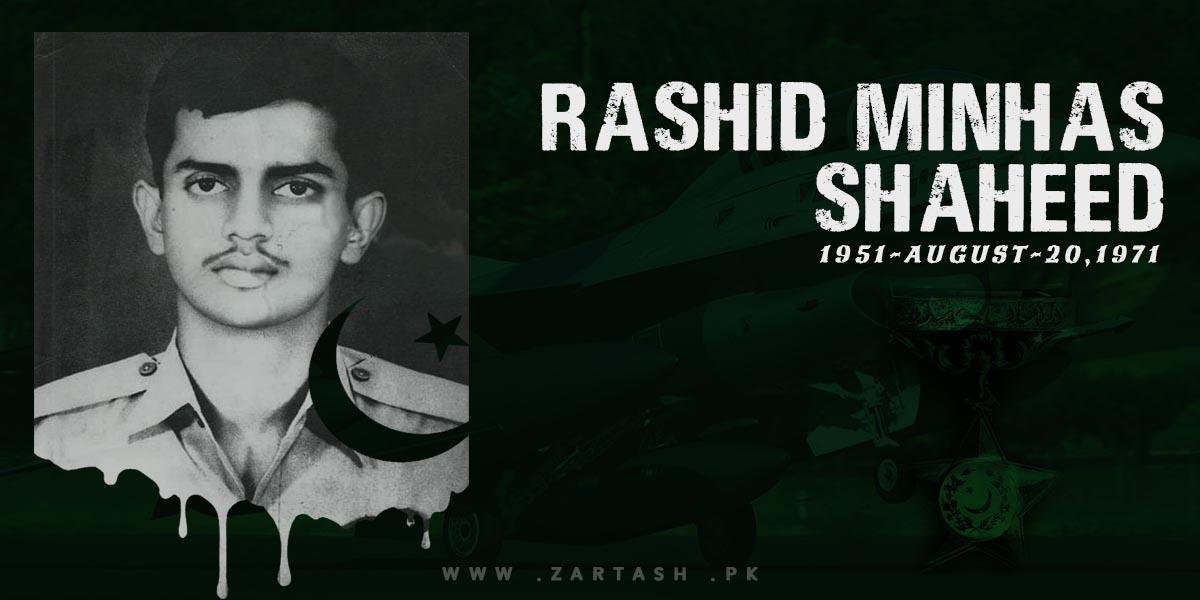
Pilot Officer Rashid Minhas was a Pakistan Air Force pilot who crashed his T-33 trainer near Thatta on 20 August 1971 to prevent its hijacking to India. Rashid Minhas received the Nishan-e-Haider posthumously.
Rashid Minhas Shaheed is the only Pakistan Air Force officer ever awarded the Nishan-e-Haider, Pakistan’s highest gallantry decoration. Rashid Minhas is also the youngest recipient, at 20 years of age, and the shortest-serving, with five months between his commission and his death. This article sets out his birth and schooling, the sequence of events on 20 August 1971, the citation that earned the award, the disputed crash findings recorded by a later investigator, and the fact that the other pilot in the same cockpit holds Bangladesh’s highest military award for the same flight.
Rashid Minhas Shaheed: Key Facts
The table below lists the confirmed service record of Rashid Minhas.
| Attribute | Detail |
|---|---|
| Name | Rashid Minhas |
| Born | 17 February 1951, Karachi, Sindh |
| Died | 20 August 1971, near Thatta, Sindh |
| Service | Pakistan Air Force, 13 March 1971 to 20 August 1971 |
| Rank | Pilot Officer |
| Unit | No. 2 Squadron, PAF Base Masroor, Karachi |
| Aircraft | Lockheed T-33A jet trainer |
| Award | Nishan-e-Haider, posthumous |
| Age at death | 20 years, 6 months |
Who Was Rashid Minhas?
Rashid Minhas was a Pilot Officer of the Pakistan Air Force born on 17 February 1951 in Karachi, at the PAF hospital on Drigh Road. The family belonged to the Minhas clan and settled in Karachi, where his father, Abdul Majeed Minhas, worked as a civil engineer after graduating from NED University.
Older versions of this page, and several republished summaries elsewhere, place his birth in Lahore. Karachi is the birthplace recorded in Pakistan Air Force material and in standard reference works, and Karachi is the figure used throughout this article.
Rashid Minhas collected aircraft models as a child and read on electronics and astronomy. That interest fixed his career choice early, and the Pakistan Air Force was the only service he applied to.
How Did Rashid Minhas Become a PAF Pilot?
Rashid Minhas took his early schooling in Karachi at St Patrick’s High School, then entered PAF Public School Lower Topa in 1968. Flight training followed at the Pakistan Air Force Academy at Risalpur, where he passed out with the 51st General Duties (Pilot) course.
Sources differ by one day on the commissioning date. Most give 13 March 1971 as the start of his service, while the Pakistan Air Force Academy record is cited elsewhere as 14 March 1971. Either date leaves the same total: about five months in uniform.
Rashid Minhas was posted to No. 2 Squadron at PAF Base Masroor in Karachi, a conversion unit flying the Lockheed T-33A. The T-33A is a two-seat jet trainer with dual controls, which means the instructor in the rear seat can fly the aircraft independently of the pilot in front. That design detail decided what happened on 20 August 1971.
How Did Rashid Minhas Die?
Rashid Minhas died when his T-33A crashed near Thatta on 20 August 1971 during an attempted hijacking by his instructor. The sequence recorded in the Pakistan Air Force account runs as follows.
- Rashid Minhas taxied toward the runway at PAF Base Masroor late in the morning of 20 August 1971 for his second solo flight on the T-33A.
- Flight Lieutenant Matiur Rahman, a Bengali instructor pilot at the base, signalled the aircraft to stop, climbed into the instructor’s seat, and took control.
- The aircraft took off and turned toward the Indian border, roughly 100 miles east of Karachi.
- Rashid Minhas transmitted a message to Masroor air traffic control reporting that the aircraft was being hijacked.
- The two pilots fought for the dual controls during the flight.
- The T-33A struck the ground near Thatta, in the area that is now Sujawal District, about 32 miles from the Indian border. Both pilots died.
The 1971 war between India and Pakistan was three months away at that point, but East Pakistan had been in armed conflict since March. Matiur Rahman was attempting to reach India and join the Bangladesh liberation struggle. The wider Pakistan military calendar treats a separate conflict, the 1965 war marked every year as Defence Day of Pakistan, as the reference point for air force commemoration, and the 20 August anniversary sits outside it.
The Cecil Chaudhry Investigation Account
According to an account attributed to Group Captain Cecil Chaudhry and reported by the writer Yawar A. Mazhar in 2004, the accident investigation found the aircraft hit the ground nose first, the canopy was missing, and the body of Matiur Rahman lay outside the wreckage with injuries consistent with high-speed exposure to the airstream. On that reading, Rashid Minhas jettisoned the canopy at low altitude, throwing out the unstrapped instructor, by which point the aircraft was too low to recover. This account is one investigator’s reconstruction rather than the official version, and the Nishan-e-Haider citation remains the primary record.
Why Did Rashid Minhas Receive the Nishan-e-Haider?
The Nishan-e-Haider citation credits Rashid Minhas with forcing the aircraft into the ground 32 miles short of the Indian border rather than allowing it to be flown out of Pakistani airspace. The award was conferred posthumously.
Three records attach to that award. Rashid Minhas is the first and only Pakistan Air Force officer among the eleven Nishan-e-Haider recipients. Rashid Minhas is the youngest recipient, aged 20 years and six months. Rashid Minhas is also the shortest-serving recipient, with a service record covering only 13 March to 20 August 1971.
Why Does Bangladesh Honour Matiur Rahman?
Flight Lieutenant Matiur Rahman holds Bir Sreshtho, the highest military award of Bangladesh, for the same flight for which Rashid Minhas holds the Nishan-e-Haider. Both awards are genuine, both are posthumous, and both countries record the event in their official military histories.
Matiur Rahman was born on 29 October 1941 at Ramnagar in Narsingdi and was commissioned into the Pakistan Air Force on 22 June 1963. Bangladesh gazetted the seven Bir Sreshtho awards on 15 December 1973, and Matiur Rahman was named among them for attempting to take the aircraft to India in support of the liberation war. His remains were buried in Pakistan and were repatriated to Bangladesh on 24 June 2006, then reburied at the Martyred Intellectuals Graveyard in Mirpur, Dhaka. Bangladesh Air Force Base Matiur Rahman at Jessore carries his name.
The two decorations describe the same twenty minutes from opposite sides of a war that ended with the separation of East Pakistan. Pakistan awarded its highest honour for stopping the aircraft; Bangladesh awarded its highest honour for the attempt to fly it. Neither award cancels the other, and the record of both is the accurate statement of what happened.
How Does Pakistan Remember Rashid Minhas?
Pakistan marks the martyrdom anniversary of Rashid Minhas every 20 August with Pakistan Air Force ceremonies, ISPR statements, and press features. The 17 February birthday draws a second, smaller round of coverage each year.
Three permanent memorials carry his name. The Pakistan Air Force base at Kamra in Attock District was renamed PAF Base Minhas, and is commonly written as Minhas-Kamra. Rashid Minhas Road is a main arterial route in Karachi. Pakistan Post issued a two-rupee commemorative stamp bearing his portrait in December 2003, in a print run of 500,000 copies.
School textbooks in Pakistan place Rashid Minhas alongside the other national heroes of Pakistan recognised for wartime service, which is why the name is familiar to readers who have never seen a T-33A. The Pakistan Air Force separately commemorates Marium Mukhtiar, the first female fighter pilot in PAF history to die in the line of duty, whose Tamgha-i-Basalat is a different class of award from the Nishan-e-Haider.
Frequently Asked Questions About Rashid Minhas
Who was Rashid Minhas?
Rashid Minhas was a Pilot Officer of the Pakistan Air Force, born on 17 February 1951 in Karachi, who died on 20 August 1971 and received the Nishan-e-Haider posthumously.
How did Rashid Minhas die?
Rashid Minhas died when his T-33A trainer crashed near Thatta on 20 August 1971. His instructor, Flight Lieutenant Matiur Rahman, had taken control of the aircraft to fly it to India.
Why did Rashid Minhas get the Nishan-e-Haider?
The citation credits Rashid Minhas with forcing the hijacked aircraft to crash 32 miles from the Indian border instead of letting it reach Indian territory. The award was conferred posthumously.
How old was Rashid Minhas when he died?
Rashid Minhas was 20 years and six months old on 20 August 1971. No younger person has received the Nishan-e-Haider, and no recipient has served for a shorter period.
What is named after Rashid Minhas?
PAF Base Minhas at Kamra carries his name, as does Rashid Minhas Road in Karachi. Pakistan Post issued a two-rupee stamp bearing his portrait in December 2003.
Last Thoughts on Rashid Minhas Shaheed
Rashid Minhas flew for five months and one week. In that time he completed a conversion course, made one solo flight, and on the second one faced a decision with no training syllabus behind it. The Nishan-e-Haider that followed put a 20-year-old Pilot Officer into the same list as generals and majors who had fought full campaigns.
The flight of 20 August 1971 also produced Bangladesh’s Bir Sreshtho for the pilot in the other seat, which makes this one of the few events decorated at the highest level by two states at once. Reading the record with both awards in it does not diminish either man; it simply describes what a partition of a country looks like inside a single cockpit.
