
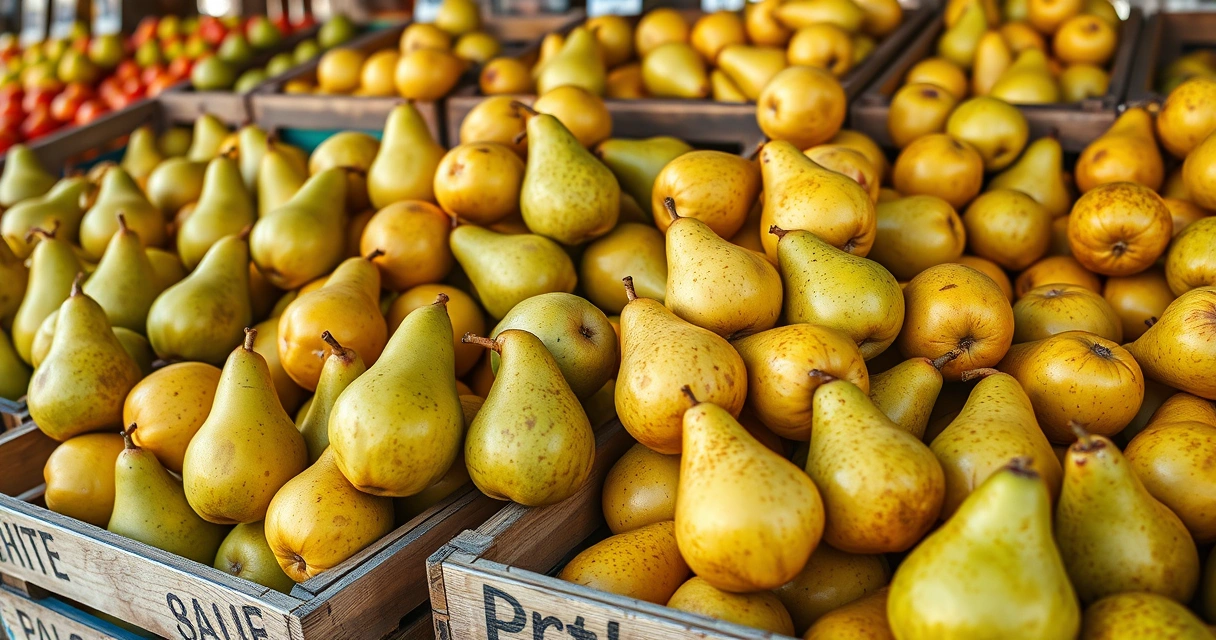
Pear season in Pakistan runs from July to September and peaks in August. Pear (ناشپاتی), called nashpati, comes from Khyber Pakhtunkhwa and Punjab, and the season closes as autumn begins in September.
Pear is a short season fruit with a long list of varieties behind it. Set against the wider calendar of seasonal fruits in Pakistan, the pear window is one of the narrowest of the year, which is why pear disappears from the stalls while apple and pomegranate are still arriving.
This page gives the pear months, a month by month availability table, the pear varieties grown in Pakistan, the difference between desi nashpati and Asian pear, the growing regions, and what fills the market during the nine months when local pear is not picked.
When Is Pear Season in Pakistan?
Pear season in Pakistan starts in July, peaks in August, and ends in September. The first lots reach the market from the plains of Khyber Pakhtunkhwa in July, supply is heaviest through August, and the last fruit clears in the first half of September.
Pear is one of the fruit seasons that close in September, alongside mango (آم), fig (انجیر), and fresh dates (کھجور). The list of September fruits in Pakistan shows which fruits replace pear on the stall as autumn opens.
Ten weeks carry the entire local crop, which makes pear one of the tightest fruit windows in the Pakistani year. Apple, by comparison, is harvested over five months and stored for a further six, while pear is picked, sold, and gone. The table below shows pear status in every month of the Pakistani market year.
| Month | Pear status | Supply source |
|---|---|---|
| January | Out of local season | Imported |
| February | Out of local season | Imported |
| March | Out of local season | Imported |
| April | Out of local season | Imported |
| May | Out of local season | Imported |
| June | Out of local season | Imported |
| July | Season starts | Khyber Pakhtunkhwa, Punjab |
| August | At peak | Khyber Pakhtunkhwa, Punjab |
| September | Season ends | Khyber Pakhtunkhwa, Punjab |
| October | Out of local season | Imported |
| November | Out of local season | Imported |
| December | Out of local season | Imported |
Which Pear Varieties Grow in Pakistan?
Nine pear varieties have been grown and formally assessed in Pakistan: Le Conte, Bagugosha, Bartlett, Concord, Pear Red, Pear White, Kashmiri Nashpati, Kashmiri Nakh, and the local Pear Selection-1. A variety trial in Soon Valley, published in the American Journal of Plant Sciences in 2018, measured all nine and named Bagugosha the strongest choice for commercial cultivation on taste, size, and yield.
The table below lists the pear varieties recorded in that trial with their type and their measured trait.
| Variety | Type | Measured trait in the Soon Valley trial |
|---|---|---|
| Bagugosha | European pear | Heaviest fruit at 205.2 grams; rated best for commercial cultivation |
| Kashmiri Nashpati | European pear | Longest fruit at 87.0 millimetres |
| Le Conte | European and Asian hybrid | Lowest titratable acidity at 0.29 percent |
| Bartlett | European pear | Soft fleshed dessert pear, assessed in the same trial |
| Concord | European pear | Assessed in the same trial |
| Pear Red | European pear | Red skinned selection assessed in the same trial |
| Pear White | European pear | Pale skinned selection assessed in the same trial |
| Kashmiri Nakh | Asian pear | Hard fleshed sand pear type |
| Pear Selection-1 | Local selection | Numbered selection assessed in the same trial |
Bagugosha, also written Babugosha, is the variety most Pakistani buyers mean by nashpati: a yellow green pear with smooth skin and soft flesh once ripe. Le Conte is a hybrid of the European and Asian pear and holds the lowest acidity of the nine, which makes Le Conte the mildest tasting of the group.
What Is the Difference Between Desi Nashpati and Asian Pear?
Desi nashpati is a European pear that softens after picking, and Asian pear (ایشیائی ناشپاتی) is a round hard fleshed sand pear that is eaten firm. Both reach Pakistani markets in the same July to September window, and Asian pear also peaks in August.
| Attribute | Desi nashpati | Asian pear |
|---|---|---|
| Species | Pyrus communis | Pyrus pyrifolia |
| Other names | Babugosha, Bagugosha, nashpati | Nakh, patharnakh, gola pear, Chinese sand pear |
| Shape | Classic tapered pear shape | Round, close to an apple in outline |
| Flesh | Soft and buttery when ripe | Crisp and firm, with gritty stone cells |
| Eaten | After softening off the tree | Firm, straight after picking |
| Season in Pakistan | July to September, peak August | July to September, peak August |
| Main growing areas | Khyber Pakhtunkhwa, Punjab | Khyber Pakhtunkhwa, Potohar Punjab |
Asian pear is native to Japan and China and has been grown in the Punjab region for generations, which is why the nakh name is older in local trade than the Asian pear label. Buyers who expect softness from a nakh usually mistake its firmness for unripeness, when a firm nakh is the ripe state of that fruit.
Where Are Pears Grown in Pakistan?
Pears grow mainly in the plains of Khyber Pakhtunkhwa, around Peshawar, Mardan, and the Hazara division, with a smaller area in the temperate pockets of Punjab. Khyber Pakhtunkhwa produces almost the entire national crop.
| Region | Main areas | Area under pear | Production |
|---|---|---|---|
| Khyber Pakhtunkhwa | Peshawar, Mardan, Hazara division | 1,589 hectares | 16,087 tonnes |
| Punjab | Temperate pockets including Soon Valley, Khushab district | 13 hectares | Small commercial volume |
| Pakistan total | All regions | 1,820 hectares | 16,569 tonnes |
Those figures come from the Soon Valley variety study and show how narrow the pear base is: 1,820 hectares nationally against tens of thousands of hectares under apple (سیب). A crop that small, harvested over roughly ten weeks, explains why pear prices climb sharply once September starts.
Soon Valley sits in the north west of Khushab district in Punjab and is the site where the nine varieties above were compared, so the valley matters to Pakistani pear breeding out of proportion to its planted area.
Pear needs a winter chilling period to set fruit properly, which is what confines the crop to the cooler plains and valleys of Khyber Pakhtunkhwa and to a small number of temperate pockets in Punjab. The southern plains of Sindh and southern Punjab do not accumulate enough winter chilling for commercial pear, which is why pear is absent from the fruit belts that grow mango, banana (کیلا), and papaya (پپیتا). Pear also bruises easily and does not hold well outside cold storage, so most of the crop is sold within days of picking rather than held back for later weeks.
Is Pear Available in Pakistan Outside the Season?
Pear is available outside the season, and that fruit is imported. China was the largest supplier of pear to Pakistan in 2024, sending more than ten times the volume of the second largest supplier, the United Arab Emirates. Imports of apple, pear, and quince (بہی) into Pakistan were worth 10.4 million US dollars in 2023.
Imported pear sits beside other imported fruit through the cool months, and the pineapple season in Pakistan (انناس) follows the same import driven pattern from November to March. Local pear and imported pear are easy to separate on the stall: imported fruit arrives in printed fibreboard cartons with individual foam sleeves, while local pear arrives loose in wooden crates.
FAQs About Pear Season in Pakistan
In which month is pear season in Pakistan?
Pear season runs from July to September and peaks in August. Local pear leaves the market in the first half of September, and pear sold in other months is imported.
What is nashpati called in English?
Nashpati is the Urdu name for pear. The soft fleshed Bagugosha type is the common market pear, and the round hard fleshed nakh is the Asian pear or Chinese sand pear.
Which province grows the most pears in Pakistan?
Khyber Pakhtunkhwa grows almost all of it, holding 1,589 hectares of the national 1,820 hectares under pear and producing 16,087 tonnes of the 16,569 tonne national crop.
Is Asian pear the same as nashpati in Pakistan?
No. Asian pear, sold as nakh, is round, crisp, and eaten firm. Desi nashpati is tapered and soft when ripe. Both are picked from July to September.
Where does imported pear in Pakistan come from?
China supplied the largest share of pear imported into Pakistan in 2024, more than ten times the volume from the United Arab Emirates, which was the second largest supplier.
Last Thoughts on Pear Season in Pakistan
Pear season in Pakistan is short, concentrated, and almost entirely a Khyber Pakhtunkhwa crop. Ten weeks from July to September carry the whole local harvest, August holds the peak, and 1,820 hectares nationally produce roughly 16,569 tonnes, which is a fraction of what the apple orchards send to the same markets. Buyers who want Bagugosha at its best shop in August, buyers who want the crisp nakh have the same window, and anyone buying pear between October and June is buying imported fruit, most of it from China. Knowing which of the two pears is on the stall matters as much as knowing the month, because a firm nakh and an unripe nashpati look similar and eat nothing alike.
