
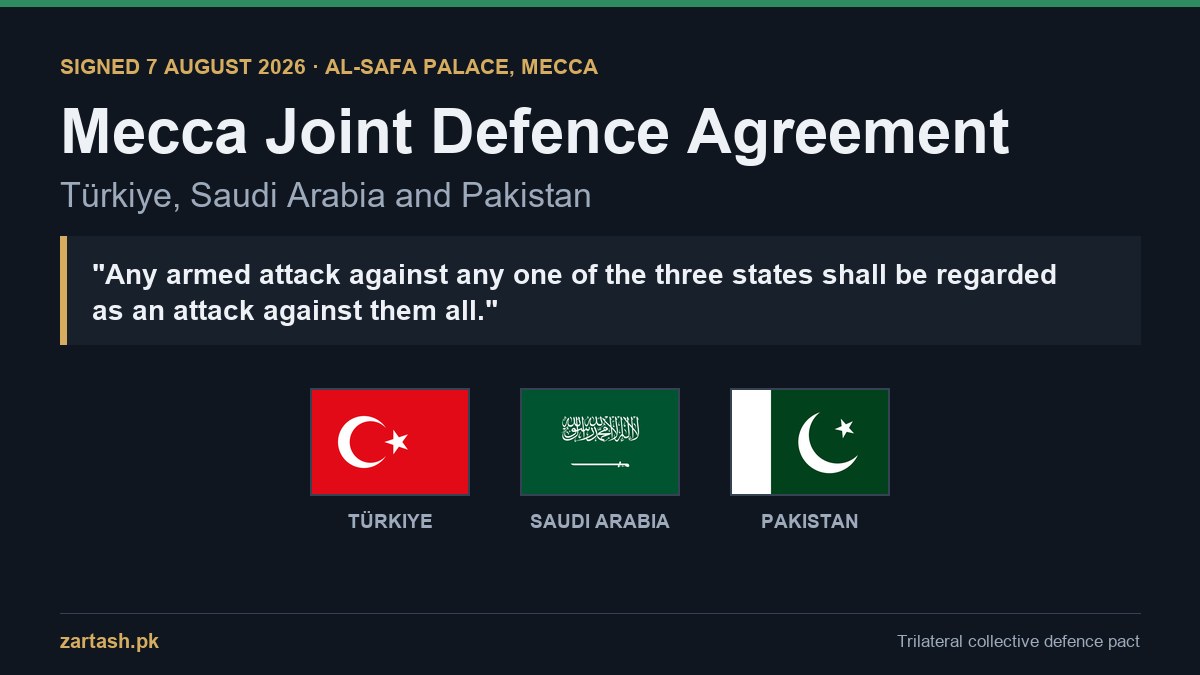
Türkiye, Saudi Arabia and Pakistan signed the Mecca Joint Defence Agreement on 7 August 2026, a trilateral pact under which an armed attack against any one of the three states is to be regarded as an attack against them all.
The signing took place at Al-Safa Palace in Mecca. Saudi Crown Prince and Prime Minister Mohammed bin Salman, Turkish President Recep Tayyip Erdoğan and Pakistani Prime Minister Shehbaz Sharif signed in a joint ceremony, and the text of a joint statement was released through the Saudi Press Agency and Pakistan’s Ministry of Foreign Affairs. Pakistani Prime Minister Sharif travelled to the Kingdom accompanied by Chief of Army Staff Field Marshal Asim Munir.
This page sets out what the agreement actually says, what it does not say, how it relates to the bilateral pact Pakistan and Saudi Arabia signed in 2025, the structure the three governments have described, the nuclear question, and how other capitals have responded. Where a claim comes from analysis rather than from the governments involved, it is labelled as such, and the several important things that remain undisclosed are listed rather than filled in.
What Does the Mecca Joint Defence Agreement Say?
The operative clause released in the joint statement is a single sentence. Any armed attack against any one of the three states shall be regarded as an attack against them all.
Beyond that clause, the governments have described the agreement as intended to strengthen collective deterrence against aggression and to provide for the enhancement of all aspects of defence cooperation. Reporting on the signing has listed intelligence sharing, joint exercises, defence technology collaboration, training and long term strategic coordination among the areas covered.
Two qualifications were attached almost immediately by the signatories themselves. Turkish officials described the pact as defensive in nature and not directed at any particular country. The three governments also indicated that it is open to other regional states and that it does not supersede existing bilateral arrangements, which matters because all three already hold separate defence relationships that remain in force.
What Is the Agreement Called?
The name is not settled across sources, which is worth knowing if you are searching for it. The joint statement and Turkish officials use Mecca Joint Defence Agreement, and that is the form used on this page. Several outlets have reported it as the Mecca Joint Deterrence Agreement. In shorthand it is widely called the Mecca Pact or the Mecca Agreement, and the spelling Makkah appears in some Gulf coverage. All refer to the same document signed on 7 August 2026.
How Is It Different From the 2025 Pakistan Saudi Arabia Pact?
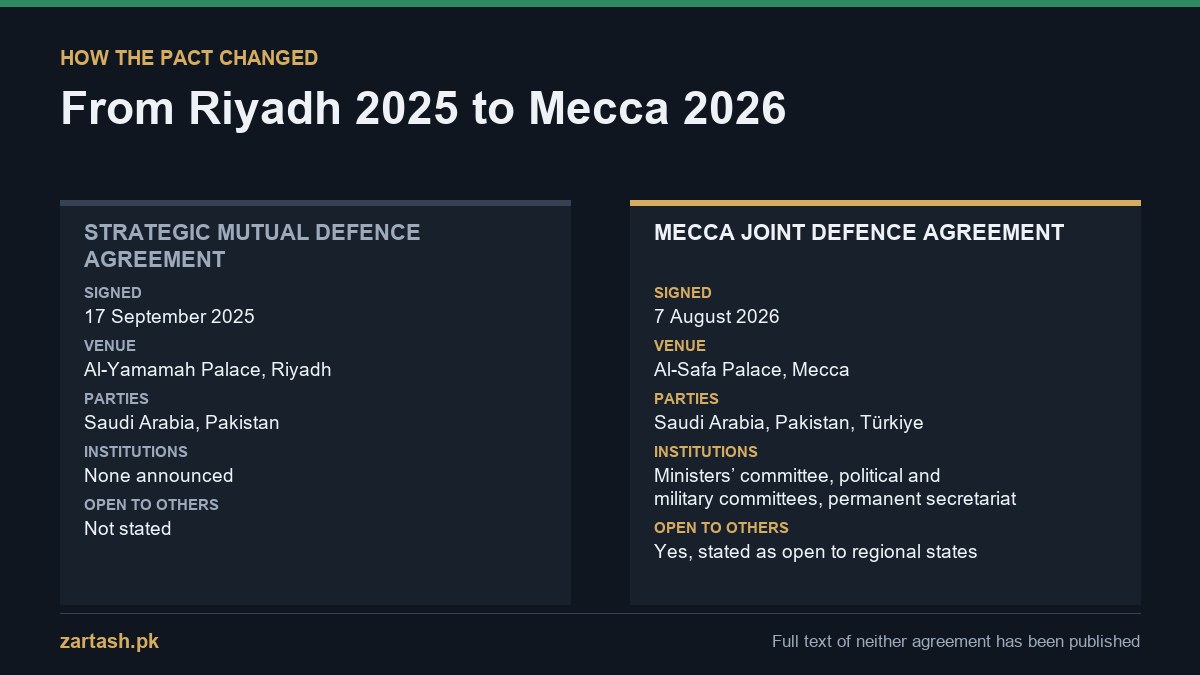
The Mecca agreement builds directly on the Strategic Mutual Defence Agreement that Pakistan and Saudi Arabia signed on 17 September 2025 at Al-Yamamah Palace in Riyadh. That bilateral pact formalised decades of military cooperation between the two countries and used comparable language, committing each to treat aggression against one as aggression against both.
The change in 2026 is the addition of Türkiye, which converts a bilateral understanding into a three way commitment and brings a NATO member state into the arrangement. The other change is institutional. The 2025 agreement was widely described at the time as signal heavy and detail light. The 2026 agreement arrives with a described machinery attached to it.
| Strategic Mutual Defence Agreement | Mecca Joint Defence Agreement | |
|---|---|---|
| Signed | 17 September 2025 | 7 August 2026 |
| Venue | Al-Yamamah Palace, Riyadh | Al-Safa Palace, Mecca |
| Parties | Saudi Arabia, Pakistan | Saudi Arabia, Pakistan, Türkiye |
| Core clause | Aggression against either is aggression against both | An armed attack against any one is an attack against all three |
| Institutions described | None announced | Ministers’ committee, political and military committees, permanent secretariat |
| Open to new members | Not stated | Yes, stated as open to other regional states |
| Full text published | No | No |
How Will the Pact Be Run?
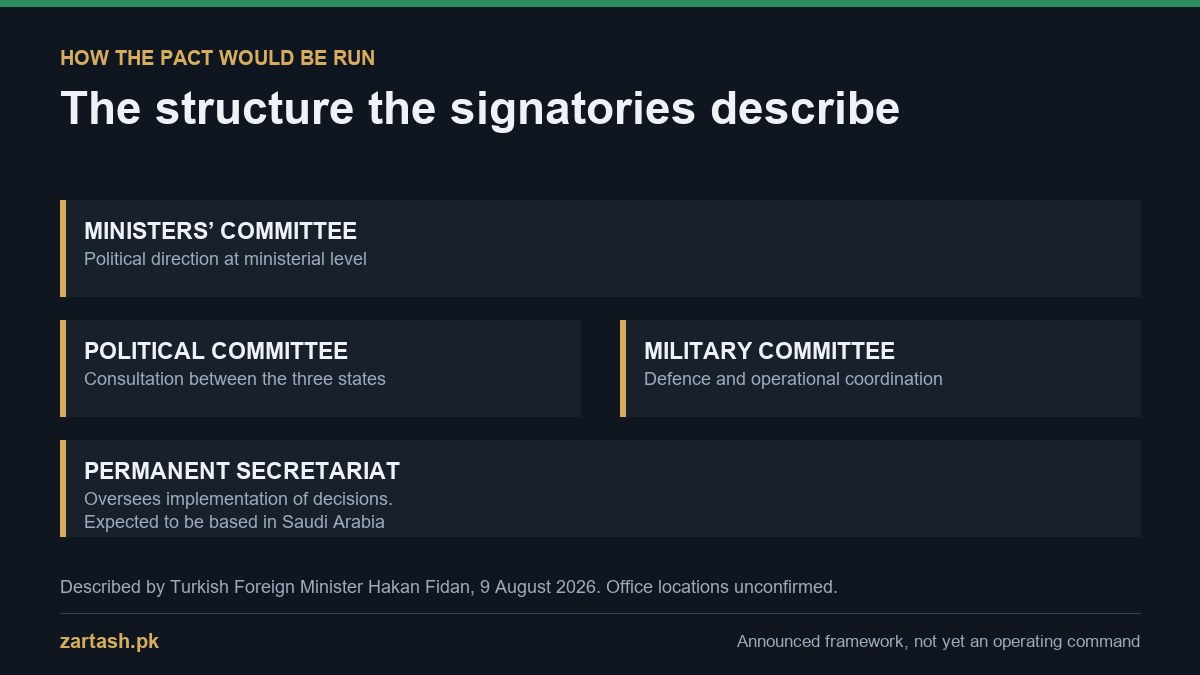
Turkish Foreign Minister Hakan Fidan set out the structure on 9 August 2026, speaking on Anadolu Agency’s Editor’s Desk programme. He said the pact would function in a way technically similar to Article 5 of the NATO treaty on collective defence, and described a ministers’ committee, political and military committees, and a permanent secretariat responsible for overseeing the implementation of decisions.
The permanent secretariat is expected to be based in Saudi Arabia. Joint military exercises and training programmes have also been described as planned. As of 9 August 2026 the specific office locations had not been confirmed.
Is This a Muslim NATO?
The comparison has been made by the signatories and by commentators, and it is accurate on one narrow point and misleading on several others.
It is accurate that the core clause mirrors the logic of NATO’s Article 5. Fidan said as much directly. It is also accurate that the described committee structure and permanent secretariat resemble the institutional shape of an alliance rather than a memorandum of understanding.
It is misleading in that NATO’s Article 5 sits on top of seventy years of integrated command, standing force structures, common procedures and a treaty text that every member has ratified through its own parliament. None of that has been announced here. Analysts at the Atlantic Council noted that previous mutual defence agreements among these same parties have not translated into the kind of response associated with Article 5. Allison Minor, who directs the council’s Rafik Hariri Center, judged that any support triggered by the pact is unlikely to be a game changer and will be highly context specific.
The honest description is that the Mecca agreement is a political commitment with an announced institutional framework, and that whether it becomes an alliance in the operational sense depends on decisions that have not yet been taken or disclosed.
Why Was It Signed Now?
The agreement was signed during the regional war involving Iran that began on 28 February 2026 following United States and Israeli strikes on Iranian targets. In the months that followed, Saudi Arabia came under repeated missile and drone attack, including from Houthi forces, with attacks threatening oil export infrastructure. The Gulf states’ confidence in United States security guarantees had already been shaken by the Israeli strike in Doha the previous year.
Each of the three governments has its own reason for signing, and the reasons are not identical.
- Saudi Arabia gains additional leverage against Iran at a point when the limits of American deterrence are being tested, and by hosting the signing in Mecca it positions itself as the convening power of a new regional arrangement.
- Pakistan is embedded more deeply into Middle Eastern security architecture, which carries prestige, influence and the prospect of economic and defence industrial returns from the Gulf.
- Türkiye extends an existing set of defence relationships into a collective framework, and opens commercial ground for a defence industry that has been expanding its export base for a decade. Ankara’s relationship with Islamabad is long standing, as the reception given to President Erdoğan on his visits to Pakistan has repeatedly shown.
Does the Pact Extend Pakistan’s Nuclear Umbrella?
This is the most consequential question attached to the agreement and it does not have a clean answer. The record is genuinely contradictory and this page does not resolve it.
Pakistani officials maintained through 2025 that the bilateral agreement did not include a nuclear umbrella, and Defence Minister Khawaja Muhammad Asif told Reuters that nuclear weapons were not on the radar of that pact. Separately, and at a different moment, Asif said that Pakistan’s nuclear programme would be made available to Saudi Arabia if needed under the pact, which was reported at the time as the first specific acknowledgement of the kind. A Saudi deputy minister for public diplomacy stated that the agreement did not represent an effort linked to any nuclear ambition and was not aimed at any country in the region.
Nothing in the published statement on the 2026 trilateral agreement mentions nuclear weapons. Analysts have generally judged that an extension of Pakistan’s deterrent to its partners is unlikely, and have cautioned that any move in that direction would unsettle regional deterrence and attract immediate international scrutiny.
What can be said accurately is this. Pakistan is a nuclear armed state and is now bound by a written mutual defence commitment to two others. That fact alone changes how planners in other capitals calculate, whatever the agreement says or does not say about warheads.
How Have Other Countries Responded?
| Capital | Response |
|---|---|
| India | Ministry of External Affairs spokesperson Randhir Jaiswal said it was a development India was closely following. India has said it will assess the implications for regional stability and national security. |
| Iran | Foreign Minister Abbas Araghchi welcomed the agreement and called for Muslim unity. Some Iranian parliamentarians questioned whether it delivers Saudi security on its own. |
| United States | No formal response in the first hours after signing. Analysts expect a broadly favourable view, given the administration’s preference for allied burden sharing on Iran. |
| Israel | No official response recorded in the immediate aftermath. |
| Egypt | Not a party. Fidan said Egypt may join once certain technical matters are sorted out. |
The Indian reaction is the one most directly relevant to readers in Pakistan. Indian defence commentary has focused on the possibility that the pact strengthens Pakistan’s position in a crisis and adds political weight to pressure for early termination of hostilities, and on the risk to India’s economic and diplomatic relationships in Riyadh. The India Pakistan relationship is the frame through which most Indian analysis of the agreement has been written.
Which Countries Could Join Next?
The agreement is described as open to other regional states. Fidan was explicit that the three signatories should not remain the limit, saying that the grouping should grow and, if necessary, bring all countries under the umbrella.
Egypt is the most frequently named candidate. A summit held in Riyadh in March 2026 included discussion among Egypt, Pakistan, Saudi Arabia and Türkiye about a four way arrangement, which did not materialise at that time. No accession mechanism has been published, so there is no public procedure by which a fourth state would actually join.
What Has Not Been Disclosed?
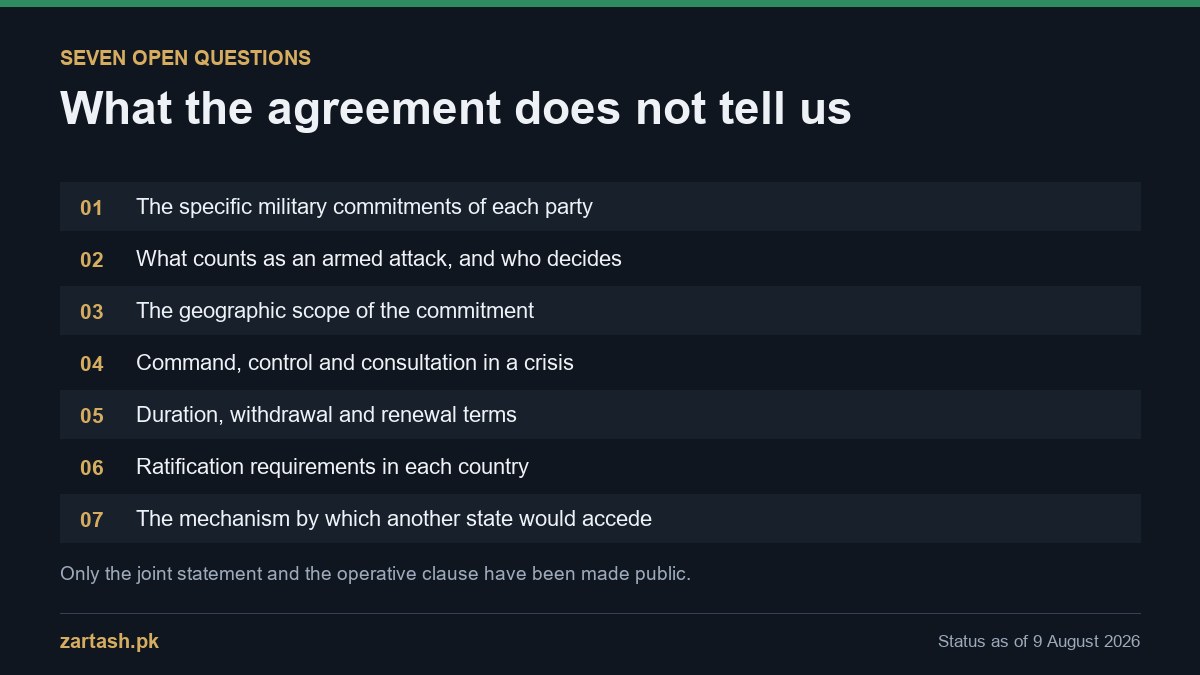
The full text of the agreement has not been released. Only the joint statement and the operative clause have been made public. The following are not known:
- The specific military commitments each party has undertaken.
- What counts as an armed attack for the purpose of triggering the clause, and who decides.
- The geographic scope of the commitment.
- Command, control and consultation arrangements in a crisis.
- The duration of the agreement, any withdrawal provision, and any renewal terms.
- Ratification requirements in each country and whether ratification has begun.
- The mechanism by which another state would accede.
That list is not a criticism of the agreement. Defence treaties are routinely announced before their texts are published and often before they are ratified. It is a caution against reading confident operational conclusions into a document nobody outside the three governments has read.
What Does It Mean for Pakistan?
For Pakistan the agreement is a continuation rather than a departure. Pakistani troops have served in Saudi Arabia in training and advisory roles across decades, and the 2025 bilateral pact had already put that relationship on a written footing. Reporting since the war began indicates Pakistan has sent troops and air defence assets to the Kingdom, and that Pakistan and Türkiye may mobilise further security support in response to threats.
The gains are real and mostly political and economic. Pakistan is now a treaty partner of the custodian of the two holy mosques and of a NATO member, which raises its standing in the Muslim world and strengthens its hand in Gulf capitals that matter enormously to its economy through remittances, oil credit and investment. It also gives Pakistan’s defence industry and its armed forces a wider platform.
The risks are equally real. A mutual defence clause is an obligation as much as a protection, and Pakistan has committed itself in writing to a region that is at war. The clause has no published threshold, so the circumstances in which Pakistan would be expected to act are undefined. Pakistan also maintains a working relationship with Iran, which shares a long border with Balochistan, and Tehran’s welcome for the agreement should not be mistaken for a guarantee that the interests never collide.
FAQs About the Mecca Joint Defence Agreement
When and where was the Mecca Joint Defence Agreement signed?
It was signed on 7 August 2026 at Al-Safa Palace in Mecca, Saudi Arabia, by Saudi Crown Prince Mohammed bin Salman, Turkish President Recep Tayyip Erdoğan and Pakistani Prime Minister Shehbaz Sharif.
What is the main clause of the Mecca pact?
Any armed attack against any one of the three states shall be regarded as an attack against them all. The stated purpose is to strengthen collective deterrence and expand defence cooperation between the signatories.
Is the Mecca agreement the same as NATO Article 5?
Turkish Foreign Minister Hakan Fidan said it is technically the same on collective defence. It lacks NATO’s integrated command, standing forces and ratified treaty text, so the comparison holds in principle rather than in practice.
Does the pact give Saudi Arabia a nuclear umbrella?
The published statement does not mention nuclear weapons. Pakistani officials have given conflicting accounts on the 2025 bilateral pact, and Saudi Arabia has said the agreement is not linked to nuclear ambition.
Can other countries join the Mecca Joint Defence Agreement?
Yes. It is described as open to other regional states, and Fidan named Egypt as a possible member once technical matters are resolved. No accession procedure has been published.
Last Thoughts on the Mecca Joint Defence Agreement
The Mecca Joint Defence Agreement is the most significant thing to happen to Pakistan’s foreign and defence posture since the 2025 pact with Saudi Arabia, and arguably since the nuclear tests. It places Pakistan inside a written collective defence arrangement with the leading Arab state and a NATO member, at a moment when the regional order that has held since the 1990s is visibly under strain.
What it is not, yet, is an alliance in the operational sense. The text is unpublished, the thresholds are undefined, the ratification is unconfirmed and the institutions exist so far as announcements rather than as buildings with staff in them. Nawaf Obaid of King’s College London called it the institutional beginning of a new regional security architecture and the beginning of the post American Middle East, and that may prove right. The word doing the work in that sentence is beginning.
For readers in Pakistan the practical measure over the next year is simple enough. Watch whether the permanent secretariat is actually established in Saudi Arabia, whether the ministers’ committee meets, whether joint exercises are held, and whether a fourth state accedes. Those four things are observable. Until they happen, the agreement remains a serious commitment on paper whose weight has not been tested.
Sources
- Joint statement of the three governments, released through the Saudi Press Agency and the Ministry of Foreign Affairs of Pakistan, 7 August 2026.
- Remarks of Turkish Foreign Minister Hakan Fidan, Anadolu Agency Editor’s Desk, 9 August 2026.
- Al Jazeera, on the terms of the agreement.
- Atlantic Council, expert dispatch on the motivations of the three signatories.
- Middle East Monitor, on the signing.
- Reuters and Ministry of External Affairs of India briefing, on the Indian response.
This page reports an agreement whose full text has not been published. It will be updated as the text, ratification status and institutional arrangements become public.
