
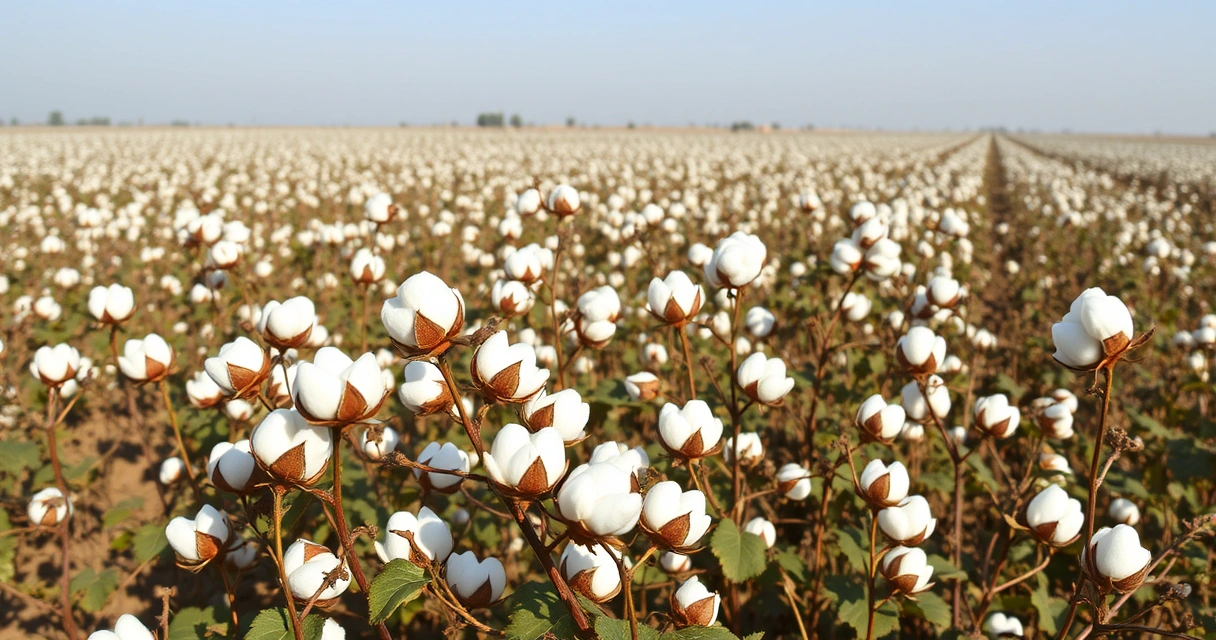
Cotton cultivation in Pakistan runs on a 1 April to 31 May sowing window in Punjab, 17,500 to 23,000 plants per acre, and a 2023-24 Punjab yield of 17.52 maunds per acre.
This page covers the sowing calendar, approved varieties and their yield potential, seed rate and spacing, land preparation, the fertiliser schedule, irrigation, weed control, pink bollworm management, other pests and diseases, and clean picking for cotton کپاس in Pakistan. The numbers come from the Punjab Agriculture Department production plan for cotton 2024, its predecessor for 2023-24, and three undated leaflets from the Directorate of Agricultural Information Punjab covering pink bollworm control, clean picking and off-season management.
Every recommendation here is Punjab specific. Punjab grows about 70 percent of Pakistan’s cotton according to the 2024 production plan, which is why the departmental literature is written for Punjab districts, but Sindh, Khyber Pakhtunkhwa and Balochistan run different sowing calendars, different approved variety lists and different pest pressure. Growers outside Punjab should take their numbers from their own provincial agriculture department. Cotton and its manufactures sit at the centre of agriculture in Pakistan, which supplies 23.4 percent of GDP.
When Is Cotton Sown in Pakistan?
Cotton in Punjab is sown between 1 April and 31 May, with sowing preferably finished by 15 May, and compulsorily by 15 May in areas affected by leaf curl virus, according to the Punjab production plan for cotton 2024.
The 2024 plan adds a second, separate package for early sowing from mid February to 31 March. Early sowing is restricted to the Faisalabad, Sahiwal, Sargodha and Multan divisions, and to triple gene varieties only. The reasoning is that an early crop completes its critical growth stages before the worst heat and the worst insect pressure of the season.
This is where the two consecutive production plans openly disagree. The 2023-24 plan instructs growers never to sow cotton in March and April, on the grounds that pink bollworm moths emerge in March and April and die naturally if they find no cotton crop to lay on. The 2024 plan reverses that for triple gene varieties and publishes a mid February start. A grower reading only one of the two would get opposite advice, so the sowing decision should be checked against the current season plan rather than an older booklet.
Punjab splits its cotton belt into two zones, and the split drives both variety choice and fertiliser dose. The central zone covers Multan, Khanewal, Vehari, Lodhran, Bahawalpur, Rahim Yar Khan, Dera Ghazi Khan, Rajanpur, Muzaffargarh and Layyah. The secondary zone covers Sahiwal, Okara, Pakpattan, Faisalabad, Toba Tek Singh, Jhang, Bhakkar, Mianwali and Kasur.
Punjab yields show how volatile the crop has become. The Crop Reporting Service series in the 2024 plan records 17.56 maunds per acre in 2018-19, a collapse to 10.50 maunds per acre in 2022-23 after the July and August floods, and a recovery to 17.52 maunds per acre in the 2023-24 second estimate, off 4,152 thousand acres for 6,028 thousand bales.
Which Cotton Varieties Are Recommended in Pakistan?
Punjab approved 45 Bt varieties, 6 non Bt varieties and 7 triple gene varieties for 2024, with yield potential running from 25 to 80 maunds per acre depending on variety and package. Triple gene varieties carry the highest published potential at 65 to 80 maunds per acre under the early sowing package.
| Variety | Type | Institute | Plants per acre | Yield potential, maunds per acre |
|---|---|---|---|---|
| CKC-05 | Triple gene | CEMB Lahore | Early sowing package | 75 to 80 |
| ICS-386 | Triple gene | Tara Crop Sciences Lahore | Early sowing package | 70 to 80 |
| CKC-06 | Triple gene | CEMB Lahore | Early sowing package | 70 to 75 |
| CKC-01 | Triple gene | CEMB Lahore | Early sowing package | 65 to 70 |
| CKC-03 | Triple gene | CEMB Lahore | Early sowing package | 65 to 70 |
| IR NIBGE-15 | Bt | NIBGE Faisalabad | 19,000 to 23,000 | 48 to 72 |
| IUB-13 | Bt | Islamia University Bahawalpur | 18,000 | 65 |
| CYTO-537 | Bt | CCRI Multan, 2022 | 17,500 to 23,000 | 60 to 65 |
| CIM-775 | Bt | CCRI Multan, 2022 | 17,500 to 23,000 | 60 to 65 |
| NIAB-898 | Bt | NIAB Faisalabad | 18,000 to 20,000 | 55 to 65 |
| NIAB-512 | Bt | NIAB Faisalabad | 17,000 to 20,000 | 55 to 60 |
| FH-492 | Bt | Cotton Research Station Faisalabad | 15,000 to 17,500 | 55 to 60 |
| FH-938 | Bt | Cotton Research Station Faisalabad | 17,000 to 18,000 | 55 to 60 |
| CYTO-535 | Bt | CCRI Multan, 2021 | 18,000 to 23,000 | 50 to 55 |
| MNH-1020 | Bt | CRI Multan | 17,500 to 23,000 | 50 to 60 |
| NIAB Kiran | Non Bt | NIAB Faisalabad | 18,000 to 20,000 | 55 to 60 |
| GS ALI-7 | Non Bt | Gohar Seed Multan | 18,000 to 20,000 | 55 to 60 |
| NIBGE-2 | Non Bt | NIBGE Faisalabad | 17,000 to 23,000 | 45 to 50 |
| CIM-610 | Non Bt | CCRI Multan | 17,000 to 21,000 | 40 to 50 |
| CYTO-226 | Non Bt | CCRI Multan | 18,000 to 20,000 | 30 to 35 |
Yield potentials in the table above are the figures printed in the Punjab production plan for cotton 2024. The plan publishes no staple length, no ginning outturn percentage and no formal approval year for any variety, so none is given here.
Two rules govern the choice. Triple gene varieties tolerate glyphosate and resist bollworms including pink bollworm, but the same plan states they do not resist armyworm, and spraying glyphosate over anything that is not a pure triple gene variety kills the crop. Bt varieties carry a refugia obligation: about 10 percent of the total cotton area must be planted to non Bt varieties so that bollworms do not build resistance to the Bt protein.
What Is the Seed Rate and Plant Spacing for Cotton?
Cotton seed rate in Punjab is 6 kg per acre of acid delinted seed or 8 kg per acre of fuzzy seed at 75 percent germination, rising to 8 kg and 10 kg at 60 percent germination, per the 2024 production plan. Early sown triple gene cotton takes only 4 to 5 kg of delinted seed per acre.
| Sowing package | Germination | Seed rate per acre | Plant spacing | Row spacing | Plants per acre |
|---|---|---|---|---|---|
| Early, mid February to 31 March | 75 percent or above | 4 to 5 kg delinted | 1.5 to 2 ft, 45.7 to 61 cm | 2.5 ft, 76.2 cm | Set locally |
| Early, mid February to 31 March | 60 percent | 5 to 6 kg delinted | 1.5 to 2 ft, 45.7 to 61 cm | 2.5 ft, 76.2 cm | Set locally |
| Normal, 1 to 30 April | 75 percent or above | 6 kg delinted, 8 kg fuzzy | 12 in, 30.5 cm | 2.5 ft, 76.2 cm | 17,500 |
| Normal, 1 to 31 May | 75 percent or above | 6 kg delinted, 8 kg fuzzy | 9 in, 22.9 cm | 2.5 ft, 76.2 cm | 23,000 |
| Normal, either month | 60 percent | 8 kg delinted, 10 kg fuzzy | As above | 2.5 ft, 76.2 cm | As above |
Three adjustments apply to every row of the table. Drill sowing takes 2 to 3 kg more seed per acre. Dibbling places 4 to 5 seeds per hill. Arrange 10 percent more seed than the calculation requires, so gaps can be filled promptly, because a plant established after the first irrigation never catches up.
Germination is measured before sowing, not assumed. Soak 100 seeds for 7 to 8 hours, spread them on wet cloth, sprinkle water two or three times a day, and count the sprouted seeds after 4 to 5 days.
Delinting is compulsory for early sowing and preferred generally. The 2024 plan puts 1 to 1.5 kg of sulphuric acid per 10 kg of seed, against about 1 litre per 10 kg in the 2023-24 plan, and both require washing until the seed is acid free, sun drying, and storage in cotton or cloth sacks on wooden planks rather than nylon bags or a bare floor. Nobody under 18 should handle acid delinting or pesticide application.
Seed dressing changed completely between the two plans, which is the clearest reason to check the current year. The 2024 plan lists imidacloprid plus tebuconazole FS 372.5 at 10 ml per kg of seed, azoxystrobin plus clothianidin 62.5 percent at 9 g per kg, and azoxystrobin plus clothianidin plus fludioxonil 72 percent WS at 9 g per kg. The 2023-24 plan listed imidacloprid plus thiodicarb at 2 g per kg, thiamethoxam 62.5 percent at 9 g per kg, and imidacloprid plus clothianidin 72 percent at 9 g per kg. Confirm current seed dressing and pesticide recommendations with the provincial agriculture extension department before buying, because approved active ingredients are revised every season.
How Is Land Prepared and Cotton Sown?
Cotton land is prepared by deep ploughing with a chisel plough, laser levelling, and incorporating the previous crop residue instead of burning it. Where a hard pan has formed, the 2024 plan runs the chisel plough twice, crosswise.
Cotton wants deep, fertile, well drained loam with low salt content, good moisture holding capacity and no hard sub surface layer, so that roots can travel down and sideways. Residue goes back into the soil with a rotavator, disc harrow or mouldboard plough.
Two sowing methods are published. In drill sowing, a kharif drill places seed 2 to 2.5 inches deep in rows 2.5 feet apart, and when the crop reaches 1.5 to 2 feet the grower skips one line and earths up the next to raise ridges پٹڑیوں. In ridge sowing, ridges are made first and seed goes on both sides of the ridge, sown dry with irrigation immediately afterwards and the water held an inch below the ridge top. Hand dibbling on ridges runs water 6 to 7 inches deep in the furrow first, then places seed one inch above the water line.
Thinning چھدرائی is done within 20 to 25 days of sowing, after a dry hoeing and before the first irrigation, and weak and diseased plants are pulled at the same time. Where virus attack is severe, the plan reverses the order and gives the first irrigation before thinning, so that infected plants can be identified and removed. Gaps are filled with seed soaked 5 to 6 hours, 4 to 5 seeds per gap.
What Fertiliser Does Cotton Need Per Acre?
Cotton in the central Punjab zone needs 100 kg nitrogen, 40 kg phosphorus and 38 kg potash per acre on poor soil, falling to 80, 30 and 38 on fertile soil, per the Punjab production plan for cotton 2024, which attributes the doses to the Soil Fertility Research Institute Lahore. Three separate schedules exist and must not be mixed.
| Package and soil class | Nitrogen kg per acre | Phosphorus kg per acre | Potash kg per acre |
|---|---|---|---|
| Early sowing, poor soil | 115 | 45 | 38 |
| Early sowing, medium soil | 100 | 40 | 38 |
| Early sowing, fertile soil | 90 | 35 | 38 |
| Normal sowing, central zone, poor soil | 100 | 40 | 38 |
| Normal sowing, central zone, medium soil | 90 | 35 | 38 |
| Normal sowing, central zone, fertile soil | 80 | 30 | 38 |
| Normal sowing, secondary zone, poor soil | 90 | 40 | 30 |
| Normal sowing, secondary zone, medium soil | 80 | 35 | 30 |
| Normal sowing, secondary zone, fertile soil | 70 | 30 | 30 |
On poor soil in the central zone the doses translate to 1.75 bags of DAP, 3.5 bags of urea and 1.5 bags of potassium sulphate per acre, using 50 kg bags in which urea carries 23 kg of nitrogen, DAP carries 9 kg of nitrogen and 23 kg of phosphorus, and potassium sulphate carries 25 kg of potash.
Timing matters more than the total. All the phosphorus and potash and a quarter of the nitrogen go in at land preparation. The remaining nitrogen is split into 4 or 5 doses under the early package and 3 or 4 doses under the normal package, with the critical timings at flowering, after bolls set, and after the first picking, and with all nitrogen finished by the last week of August. Potash goes in two splits on sandy soils, at sowing and at boll formation. A CCRI Multan trial cited in the plan found that phosphorus placed in the furrows after thinning and covered with a hoeing plough works better than the standard basal application.
Micronutrients carry their own doses. Zinc sulphate 33 percent goes in at 5 kg per acre, or the 21 percent grade at 10 kg per acre. Boric acid 17 percent goes in at 2.5 kg per acre, or borax 11 percent at 3.5 kg per acre. As a foliar alternative, boric acid 300 g plus zinc sulphate 250 g in 100 litres of water per acre is sprayed at 45, 60 and 90 days after sowing, in the morning or evening but never at noon, and never mixed with a herbicide.
How Is Cotton Irrigated?
Drill sown cotton takes its first irrigation 30 to 35 days after sowing and further irrigations every 12 to 15 days, while ridge sown cotton takes its first irrigation 3 to 4 days after the sowing water and then at 6 to 9 day intervals.
| Package and method | First irrigation | Later intervals | Last irrigation if wheat follows |
|---|---|---|---|
| Normal sowing, drill | 30 to 35 days after sowing | Every 12 to 15 days | About 10 October |
| Normal sowing, ridge | 3 to 4 days after the sowing water | 6 to 9 days for the second, third and fourth | About 15 October |
| Early sowing, drill | 35 to 40 days after sowing | Every 10 to 12 days | Not stated |
| Early sowing, ridge | 7 to 10 days after the sowing water | As the crop requires | Not stated |
The 2024 plan replaces guesswork with a field test it calls water scouting. At about 8 in the morning, walk into the field and examine six plants in turn: the first for wilting upper leaves, the second for reddening on the upper third of the stem, the third for whether the cut top snaps crisply, the fourth for whether soil taken 2 inches below the surface under the canopy forms a ball in the fist, the fifth for internode length, and the sixth for white flowers at the top. Repeat at three spots. Irrigate when four of the six indicators point to shortage. The plan also lists the visible warnings of water stress, which are a bluish cast on the leaves, shortened internodes, white flowers turning pink early, and reddening stems and leaf stalks, and it instructs growers to irrigate before those appear. Cotton draws on the canal network described in the guide to the irrigation system of Pakistan, which commands 18 million hectares.
How Are Weeds Controlled in Cotton?
Cotton weeds are controlled by hoeing 2 to 2.5 inches deep before the first irrigation, and by a pre emergence herbicide applied within 24 hours of sowing. The named weeds in the 2024 plan are itsit, madhana grass, wild amaranth, lehli, qulfa, tandla, hazardani, khabbal and deela.
Weeds do more than compete. The plan blames them for harbouring insects, for spreading cotton leaf curl virus and mealybug, and for obstructing field operations, and it instructs growers to clear the field bunds, water channels and road edges before sowing, because that is where both weeds and insects start.
| Herbicide | Timing | Dose |
|---|---|---|
| Pendimethalin 33 EC | Pre emergence, within 24 hours of sowing | 1,000 to 1,250 ml per acre |
| Metolachlor 960 EC | Pre emergence | 800 ml per acre |
| S-metolachlor 960 EC | Pre emergence | 800 ml per acre |
| S-metolachlor plus pendimethalin 960 EC | Pre emergence | 900 ml per acre |
| Acetochlor plus pendimethalin 42 EC | Pre emergence | 1,000 ml per acre |
| Glyphosate, triple gene varieties only | 25 to 30 days after emergence | 1,500 to 1,800 ml per 100 litres water |
| Haloxyfop 10.8 EC | Post emergence, grassy weeds | 400 ml per 100 litres water |
| Quizalofop 10.8 EC | Post emergence, grassy weeds | 400 ml per 100 litres water |
Every herbicide and dose in the table above is printed in the Punjab production plan for cotton 2024. Confirm current recommendations and label doses with the provincial agriculture extension department before spraying, because approved products change.
The glyphosate protocol belongs to triple gene varieties alone. Spray once all the weeds have emerged, roughly 25 to 30 days after crop emergence. The effect starts 8 to 10 days later and the kill completes in about a month. Glyphosate works better in good soil moisture وتر, and 2 kg of urea per acre is added to the spray if the crop is water stressed. Never irrigate immediately after spraying, and fit a shield on the nozzle if the crop is already 60 to 70 days old.
How Is Pink Bollworm Controlled in Cotton?
Pink bollworm گلابی سنڈی is controlled mainly by cultural measures, because the larva feeds inside the boll where sprays cannot reach it. The economic threshold is 5 larvae per 100 soft green bolls in Bt varieties, with month specific damage thresholds of 10 percent in August and 5 percent in September.
Pink bollworm is the defining cotton problem in Pakistan for one reason recorded plainly in the 2024 plan: it has no alternate host plant. It survives only inside cotton seed, inside the cotton held in ginning factories, and inside the unopened bolls on cotton sticks lying at field edges. Break those three reservoirs and the pest has nowhere to go, which is why the whole control package is about the off season rather than the crop.
The undated pink bollworm leaflet from the Directorate of Agricultural Information Punjab sets out the life cycle. The female lays eggs over 14 to 20 days and lays 100 to 250 eggs in total, singly on squares and flowers. Eggs are white and turn brown on the third day, and larvae emerge in 3 to 10 days. Newly hatched larvae enter a soft boll or flower within half an hour to an hour. The larva passes through four instars, is white with a dark brown head at first, the exact colour of cotton lint, and only turns pink by the third and fourth instar. Feeding completes in 8 to 16 days and pupation in 6 to 7 days, and the adult lives 2 to 29 days. Short cycle moths emerge in March and April, while diapausing individuals emerge in July and August and cause the damage. The leaflet also records a severe increase in pink bollworm attack on Bt varieties over the three preceding seasons.
Two field diagnostics matter. In flowers, the larva webs the petals together with saliva so the flower cannot open and takes a churn like rosette shape. In bolls, the entry hole closes over and cannot be seen, so an infested boll looks healthy from outside and the loss only appears at picking, when the boll fails to open and the lint is discoloured. Scouting therefore means cutting bolls open, not looking at them: cut 100 soft green bolls and count the larvae inside, twice a week.
| Measure | Specification |
|---|---|
| Economic threshold | 5 larvae per 100 green bolls in Bt varieties |
| Damage threshold by month | 10 percent in August, 5 percent in September |
| Scouting frequency | Twice a week, cutting bolls open |
| Sex pheromone traps | 4 traps per 20 acre block, that is 1 per 5 acres, or 1 per 10 acres on larger blocks with a minimum of 5, lure changed every 15 days |
| PB Ropes | Applied at the start of squaring, roughly a 40 to 45 day crop, effective for 100 days, worthwhile on blocks above 50 acres |
| Crop termination | No irrigation after 30 September and no late nitrogen |
| Pink Boll Worm Manager machine | CCRI Multan design, strips leftover bolls, about 3 maunds per acre gain, about Rs 1,000 per acre, 15 to 20 acres a day |
| Stick and stubble deadline | Sticks incorporated or removed and deep ploughed by 31 December, cut and destroyed and ginning factories cleaned by 31 January |
| Stick storage | Small heaps away from cotton fields, standing upright with butt ends down, at least 1.5 ft off the ground, turned over in February and March |
| Stored seed fumigation | Aluminium phosphide at 30 tablets per 1,000 cubic feet |
The off season leaflet adds the number that explains the urgency: about 80 percent of the opened and affected bolls left in the field after the last picking contain diapausing pink bollworm larvae. It also instructs growers to run a chisel plough immediately after cutting the sticks, and to install at least one sex pheromone trap at every cotton stick heap, ginning factory and oil mill.
Chemical control is the last resort and only at threshold. The pink bollworm leaflet lists triazophos 40 EC at 1 litre per acre, deltamethrin 2.5 EC at 250 ml, cypermethrin 120 SC at 100 to 120 ml, and bifenthrin 10 percent at 300 ml, all in 100 litres of water per acre, with the instruction never to spray the same chemical group repeatedly. The 2024 production plan adds lambda cyhalothrin 2.5 EC at 330 ml and lambda cyhalothrin plus chlorantraniliprole 150 ZC at 160 ml per acre. These doses come from a 2024 booklet and an undated leaflet, so confirm current recommendations with the provincial agriculture extension department before spraying.
Which Other Pests and Diseases Attack Cotton?
Cotton in Punjab carries sucking pests, four bollworms and seven named diseases, each with a published economic threshold or a named control. The 2024 plan requires pest scouting twice a week, in the morning or evening, before any spray decision.
| Pest | Economic threshold | Non chemical control |
|---|---|---|
| Jassid چست تیلہ | 1 adult or nymph per leaf | 10 yellow sticky traps per acre, no okra beside cotton |
| Whitefly سفید مکھی | 5 adults or nymphs per leaf | 8 to 10 yellow sticky traps per acre, 20 Chrysoperla cards per acre |
| Thrips | 10 nymphs or adults per leaf | Weed free fields, sowing at the recommended time |
| Dusky cotton bug | 10 per green boll | Destroy sticks and residue after picking |
| Spotted bollworm | 3 larvae per 25 plants, or 10 percent damaged squares, flowers and bolls | Collect and bury fallen squares from 15 July to 30 August |
| American bollworm | 3 small larvae or 5 brown eggs per 25 plants | 20 Trichogramma cards per acre, light traps, irrigate after picking |
| Pink bollworm | 5 larvae per 100 green bolls | PB Ropes, pheromone traps, off season stick destruction |
Scouting has a defined method. For sucking pests, divide the field into five blocks and examine 20 leaves in each, taking a top leaf from the first plant, a fully expanded middle leaf from the second and a lower leaf from the third, then average the count per leaf against the threshold. For bollworms, take five plants at each of five spots, count the larvae on all 25 and divide by 25. Trichogramma cards go in at 10 to 15 per acre every 7 days according to the beneficial insect section, and at 20 per acre in the American bollworm row of the same booklet.
Cotton leaf curl virus is the disease that reshaped the crop. The first sign is thickening of the leaf veins, visible when the leaf is held up to sunlight, followed by upward curling of the leaf margins, a small leaf like outgrowth on the underside called an enation, and stunting. Control is indirect, through virus resistant varieties, whitefly management with insect growth regulators, destruction of alternate host plants, and destruction of cotton ratoon and stubble by 31 January. The plan adds a foliar schedule of zinc sulphate 250 g plus borax 250 g plus magnesium sulphate 300 g in 100 litres of water per acre at 60, 75 and 90 days.
Six fungal and bacterial diseases follow. Twig and stem blight is caused by Botryodiplodia species, favoured by 27 to 35 degrees Celsius with humidity above 80 percent, and treated with thiophanate methyl at 250 to 300 g or difenoconazole at 125 ml per acre. Bacterial leaf blight is Xanthomonas campestris pv. malvacearum, is seed borne, and is handled by soaking delinted seed in streptomycin sulphate at 1 gram per 10 litres of water for 2 hours. Boll rot is caused by the bacterium Pantoea agglomerans carried by bugs that puncture bolls. Sooty mould grows on the honeydew of sucking pests and is sprayed with trifloxystrobin 65 g plus sulphur 250 g per 100 litres. Wilt is Fusarium oxysporum and Verticillium dahliae, and root rot is Rhizoctonia solani, both managed by fungicide seed dressing and added organic matter. All of these product names and doses come from the 2024 booklet, and current recommendations should be confirmed with the provincial agriculture extension department.
How Should Cotton Be Picked and Stored?
Cotton picking starts when about 40 to 50 percent of bolls have opened, runs from 10 in the morning to 4 in the afternoon, and only after the dew has completely dried. The clean picking leaflet sets the interval between pickings at 15 to 20 days and starts picking at more than 50 percent open, which is the stricter of the two figures.
Clean picking is the grower’s own contribution to price. Pick from the lower part of the plant upward so trash falling from above does not land in picked cotton. Pick only fully opened bolls, and take the lint out rather than tearing off whole bolls, boll shells or stalks. Never let picked cotton touch the soil, and never pick when rain is likely or before rain wetted cotton پھٹی has dried, because damp cotton discolours and the fibre is spoiled.
Three lots must be kept separate from the main crop. Cotton from pink bollworm affected bolls goes separately, because a small proportion of stained lint downgrades the whole lot. The last picking goes separately, because its fibre is weak and its seed is not fit for sowing. Different varieties are stored separately so that fibre and seed do not mix.
Contamination rules are specific and legally backed. The picking apron جھولی must be cotton cloth. Seed cotton must be moved to the ginning factory or store in cotton cloth sacks stitched with cotton thread, and jute, polythene, polypropylene and plastic sacks are prohibited. Pickers must cover their hair with a cotton cloth so hair does not enter the lint, smoking is forbidden during picking and storage, and picking wages should be tied to the cleanliness of the cotton delivered. Children must not be involved in picking.
Storage has its own numbers. Moisture in stored seed cotton must not exceed 8 to 10 percent. The store floor should be paved and dry, or covered with dry sand and plastic, heaps should be rectangular with gaps between them for airflow, and a single heap should not exceed 100 maunds. Cotton should be sold as early as possible rather than held.
FAQs About Cotton Cultivation in Pakistan
What is the best time to sow cotton in Pakistan?
Punjab sows cotton from 1 April to 31 May and prefers sowing finished by 15 May, per the 2024 production plan. Triple gene varieties can be sown early, from mid February to 31 March.
How much cotton seed is needed per acre?
Six kg per acre of acid delinted seed or 8 kg of fuzzy seed at 75 percent germination, rising to 8 and 10 kg at 60 percent germination. Drill sowing takes 2 to 3 kg more.
What is the economic threshold for pink bollworm?
Five larvae per 100 soft green bolls in Bt varieties, or 10 percent damage in August and 5 percent in September. Cut bolls open to scout, because the entry hole closes over.
How many plants per acre does cotton need?
17,500 plants per acre for April sowing at 12 inch plant spacing, and 23,000 for May sowing at 9 inch spacing, both in rows 2.5 feet apart.
Why must cotton sticks be destroyed by 31 January?
Pink bollworm has no alternate host and overwinters inside unopened bolls on cotton sticks, so destroying sticks, stubble and ginning trash by 31 January removes next season’s infestation source.
Last Thoughts on Cotton Cultivation in Pakistan
Cotton cultivation in Pakistan is now organised around one pest. The sowing window, the refugia rule, the crop termination dates, the PB Rope timing and the 31 January stick deadline all exist because pink bollworm has no alternate host and survives only in cotton seed, ginning trash and leftover bolls. Punjab yields tell the rest of the story, falling to 10.50 maunds per acre in 2022-23 and recovering to 17.52 maunds per acre in 2023-24 against variety potentials of 65 to 80 maunds. The gap is closed by the ordinary decisions in the tables above: sowing inside the window, setting the plant population at 17,500 or 23,000 per acre, finishing nitrogen by the last week of August, scouting twice a week against the published thresholds, and picking clean into cotton sacks. Two consecutive Punjab production plans already disagree on whether cotton may be sown before April, and the seed dressing list was replaced entirely between them, so the current season plan and the local extension office should settle any question this page answers from a booklet.
