
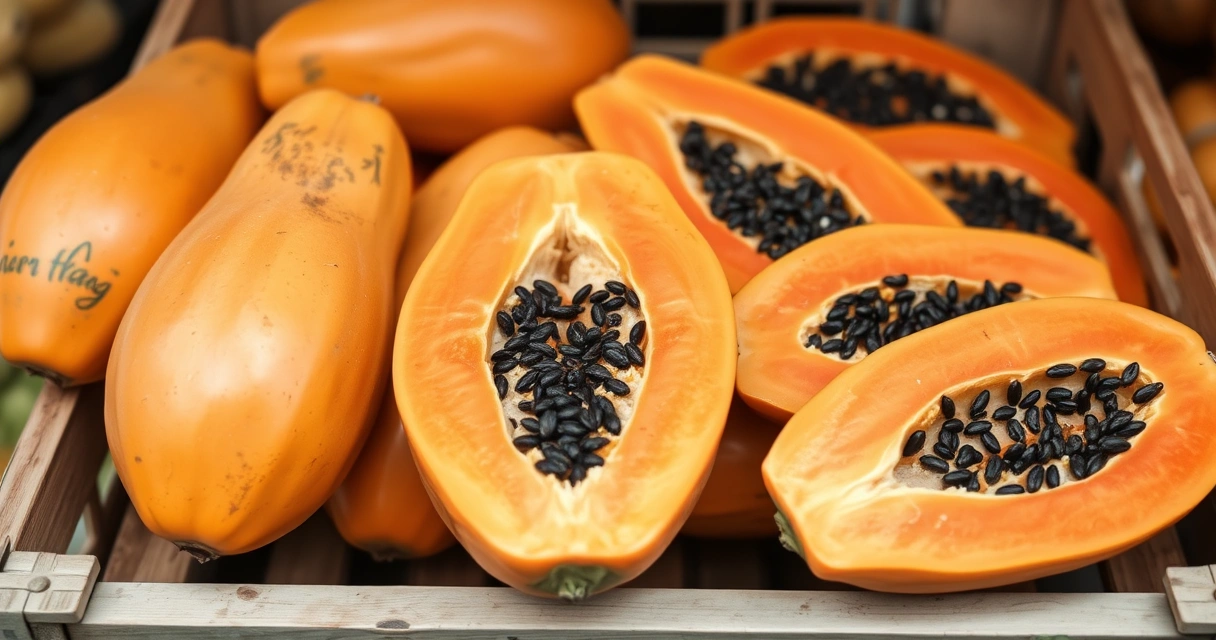
Papaya season in Pakistan runs all year. Papaya (پپیتا) is available in every month from Sindh and the coastal belt of Balochistan, and late summer is the strongest period for size, sweetness, and supply.
Papaya is one of only three fruits that never leave the Pakistani stall, alongside banana (کیلا) and lemon (لیموں). This page covers the month by month season, why papaya behaves as a year round crop, the growing regions and their production figures, the varieties planted in Pakistan, how to pick a ripe papaya, and whether any of the fruit on sale is imported. The wider calendar sits in the guide to seasonal fruits in Pakistan.
When Is Papaya Season in Pakistan?
Papaya season in Pakistan has no start and no end. Fruit is picked in every month of the year, and the strongest window runs through late summer, when August and September deliver the largest and sweetest fruit. The table below shows the state of the crop in each month.
| Month | Supply level | What to expect |
|---|---|---|
| January | Steady | Cool nights slow ripening, so fruit colours more slowly on the tree |
| February | Steady | Winter set fruit reaches size, flavour is milder than summer fruit |
| March | Steady | Warming weather speeds ripening, supply climbs |
| April | Steady | Spring supply is reliable across Sindh markets |
| May | Rising | Spring set fruit matures fastest, quality improves week by week |
| June | Rising | Heat pushes sugar content up |
| July | Strong | Approach to the annual peak |
| August | Peak | Largest fruit and heaviest supply of the year |
| September | Peak | Late summer quality holds, supply at its heaviest |
| October | Strong | Peak quality carries into the first autumn weeks |
| November | Steady | Supply continues past the peak, fruit sizes down |
| December | Steady | Cool weather slows the crop without stopping it |
Late summer is the window worth planning around. September is the month papaya sits alongside apple, grapes, and the first pomegranate, and the full arrival list for that month is in the guide to September fruits in Pakistan.
Why Is Papaya Available All Year in Pakistan?
Papaya is available all year because the papaya plant flowers continuously rather than seasonally. New flowers appear at the growing tip in an unbroken succession, so a single mature plant carries open flowers, small green fruit, and near ripe fruit at the same time. Growers pick from the same plant repeatedly instead of harvesting once.
Three biological facts produce the year round pattern.
- Flowering is independent of season: papaya flowers whenever the weather stays warm and moist enough for growth, so no photoperiod cue starts or stops the crop.
- Fruit development takes five to eight months: fruit set in spring reaches maturity in about five months, while fruit set in autumn can take up to eight, so a single plant staggers its own supply across the calendar.
- Frost, not season, is the limit: papaya suffers damage at temperatures near zero degrees Celsius, which is why the crop sits in frost free Sindh and coastal Balochistan rather than in Punjab or the north.
The late summer peak follows from the same mechanism. Heat accumulation speeds fruit development, so the fruit set during the warm months ripens faster, larger, and sweeter than the fruit set during a Sindh winter.
Where Does Pakistan Grow Papaya?
Pakistan produced 12,872 tonnes of papaya from 1,999 hectares in 2023-24, according to the Ministry of National Food Security and Research. Two provinces account for the entire recorded crop.
Balochistan produced 8,879 tonnes from 1,115 hectares, and Sindh produced 3,993 tonnes from 884 hectares. The Balochistan crop grows in the coastal Lasbela belt around Uthal and Hub, where irrigation from the Hub Dam and tube wells supports banana, chiku, guava, and papaya on ground that is otherwise arid. The Sindh crop is concentrated in the Malir zone of Karachi and in Thatta district, and Thatta and Malir papaya is the fruit Karachi buyers ask for by district name for its size and sweetness.
Punjab grows papaya only in small quantities, recorded inside a combined category rather than on its own line, and Khyber Pakhtunkhwa has no recorded commercial crop. Sindh yields more fruit per hectare than the national average, at 4.5 tonnes per hectare against 4.4 tonnes nationally, but the Balochistan planted area is larger. Well managed papaya farming yields far more than either figure, with 75 to 100 tonnes per hectare per season reported as achievable under good spacing and management, which is a measure of how far the average Pakistani papaya orchard sits below its potential.
Which Papaya Varieties Grow in Pakistan?
Three variety groups are planted in Pakistan. Red Lady, Washington, and the local desi type cover almost every plant sold by Pakistani nurseries.
- Red Lady: a Taiwanese hybrid, also sold as Red Lady 786 and as Thai papaya, with red orange flesh and early fruiting. Red Lady is the variety most widely offered by commercial nurseries in Pakistan.
- Washington: an older introduced variety grown in Sindh, producing large fruit with yellow orange flesh.
- Solo types: small single serving fruit with firm flesh, planted where fruit size matters more than total weight.
- Local desi papaya: seed grown Carica papaya from local stock, less uniform in size and shape but tolerant of Sindh field conditions.
Variety choice changes the fruit far more than the growing month does. Red Lady fruit reaches usable size within a year of planting, while seed grown desi papaya takes longer and produces mixed results because papaya seedlings do not breed true.
How Do You Pick a Ripe Papaya?
Skin colour is the reliable test. A papaya that is half to three quarters yellow is ready to eat, and a papaya at colour break, meaning dark green turning light green with yellow only at the blossom end, needs two to four more days at room temperature.
Four checks separate a good papaya from a poor one. The checks are listed below in the order to apply them.
- Read the yellow coverage: half to three quarters yellow is the eating stage, while fully yellow fruit is already soft and past eating texture.
- Press the skin near the stem: ripe papaya gives slightly to thumb pressure without leaving a dent, and soft patches mean internal breakdown.
- Weigh it against its size: a heavy fruit for its size carries more flesh and less hollow cavity.
- Reject wrinkled or sunken skin: shrivelled skin means the fruit was picked immature and dried rather than ripened.
Papaya keeps for one to three weeks at 10 to 13 degrees Celsius with 85 to 90 percent relative humidity, so a whole fruit stored in the coolest part of a Pakistani kitchen holds several days without refrigeration. Cut papaya should be sealed and refrigerated and eaten within two days.
Does Pakistan Import Papaya?
No. The Ministry of National Food Security and Research recorded no fresh papaya imports in its 2023-24 country wise import tables, which means every papaya on a Pakistani stall is domestic fruit from Sindh or Balochistan.
Exports are almost as small. Pakistan exported no fresh papaya at all in 2023-24, against 3,751 kilograms shipped to Qatar in 2022-23. Papaya is a domestic market crop in Pakistan, which is the reason its price tracks local supply and weather rather than the exchange rate or the Afghan border trade that moves grapes and pomegranate prices.
FAQs About Papaya Season in Pakistan
What is the papaya season in Pakistan?
Papaya is available year round in Pakistan. The strongest period is late summer, with August and September delivering the largest fruit, the sweetest flesh, and the heaviest supply of the year.
Where is papaya grown in Pakistan?
Sindh and coastal Balochistan. Balochistan produced 8,879 tonnes in 2023-24 from the Lasbela belt, and Sindh produced 3,993 tonnes from Malir and Thatta.
What is papaya called in Urdu?
Papita. The Urdu name for papaya is papita, and the plant is botanically Carica papaya, grown in Pakistan as both hybrid and seed grown local types.
How long does a papaya take to ripen?
Two to four days at room temperature from colour break. Papaya picked at half yellow is ready immediately, and refrigeration below 10 degrees Celsius stops ripening entirely.
Does Pakistan import papaya?
No. The Ministry of National Food Security and Research recorded no fresh papaya imports in 2023-24, so Pakistani papaya on sale is grown domestically in Sindh and Balochistan.
Last Thoughts on Papaya Season in Pakistan
Papaya is the fruit that has no season in Pakistan, because the papaya plant flowers continuously and sets fruit whenever the weather stays warm. That biology puts the crop in frost free Sindh and coastal Balochistan and keeps it on the stall in every month of the year. The quality is not flat across those months. Late summer fruit is larger and sweeter because heat speeds development, so August and September are the months to buy. Balochistan now produces more recorded papaya than Sindh does, the crop is entirely domestic with no meaningful import or export trade, and the average yield sits far below what the same land could carry, which makes papaya one of the clearest cases of unused capacity in Pakistani horticulture.
