
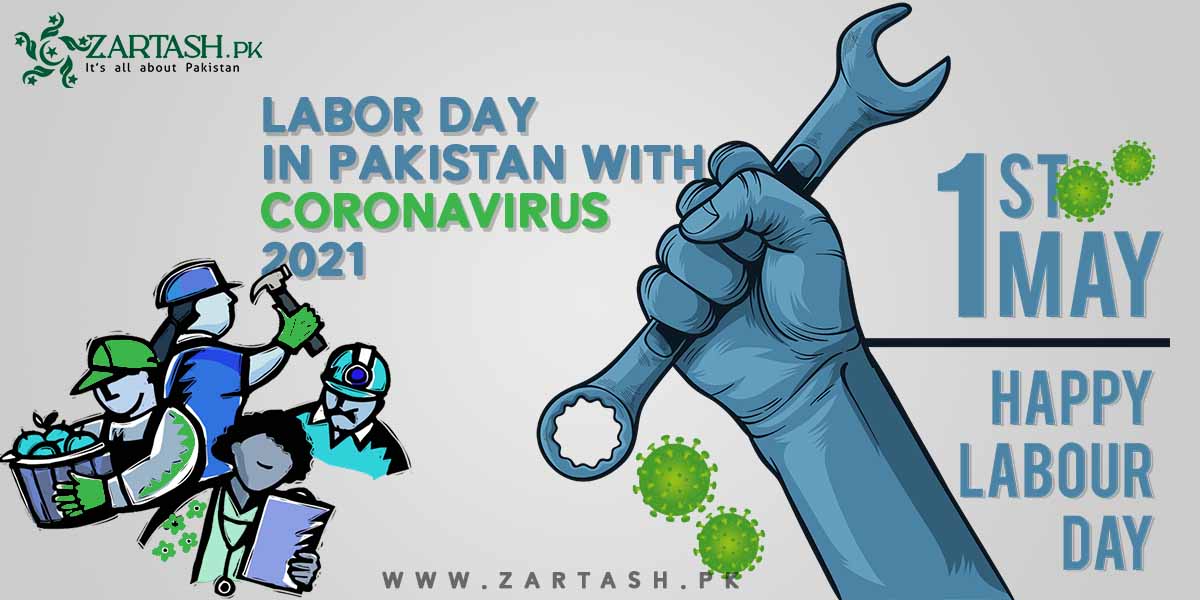
Labour Day in Pakistan falls on 1 May and is a nationwide public holiday, known locally as Youm-e-Mazdoor. Pakistan declared the date an official holiday in 1972, alongside the labour reforms introduced that year.
This article gives the date and holiday status first, then the Chicago origin of 1 May, the year Pakistan adopted it, the rights and wages workers hold today, and the share of the workforce those laws do not reach.
When Is Labour Day in Pakistan?
Labour Day in Pakistan is observed on 1 May every year. The date is fixed to the calendar rather than to a Monday, so the holiday falls on whatever weekday 1 May lands on.
Government offices, banks, schools, colleges and courts close for the day. Factories covered by provincial labour law must give the day off, and workers called in are entitled to compensatory pay or a substitute holiday under the standing orders of their province. The basic details are summarised below.
| Attribute | Detail |
|---|---|
| Observed on | 1 May, every year |
| Local name | Youm-e-Mazdoor, also called Mazdoor Day or May Day |
| Other names | International Workers’ Day, Labour Day, Labor Day |
| First observed in Pakistan | 1972, under the labour policy of that year |
| Status | Gazetted public holiday nationwide |
| Who observes it | Trade unions, labour federations, government bodies, industrial workers |
Why Is 1 May Observed as Labour Day?
1 May is observed as Labour Day because of the campaign for an eight hour working day in the United States and the Haymarket affair that followed it in Chicago in 1886.
The Federation of Organized Trades and Labor Unions called for the eight hour day to take effect from 1 May 1886, and tens of thousands of workers struck in Chicago. On 4 May 1886 a rally in Haymarket Square ended when an unidentified person threw a bomb at police officers moving to disperse the crowd. Seven police officers and at least four civilians died in the blast and the gunfire that followed, and several labour organisers were convicted and hanged in trials that later drew widespread criticism.
The First Congress of the Second International, meeting in Paris in 1889, called for an international demonstration for the eight hour day and fixed it to 1 May, which became International Workers’ Day in most of the world. The United States and Canada kept their own Labor Day on the first Monday of September, which is why the same holiday carries different dates in different countries.
When Did Pakistan Start Observing Labour Day?
Pakistan began observing Labour Day as a public holiday in 1972, when the government of Zulfikar Ali Bhutto issued a comprehensive labour policy on 10 February of that year and declared 1 May an official holiday.
The 1972 policy remains the reference point for workers’ rights in Pakistan. It created a social security framework, established the old age benefit arrangements that became the Employees’ Old-Age Benefits Institution, set up a workers’ welfare fund, guaranteed freedom of association and collective bargaining, created labour courts, introduced worker participation in factory management, and tied the minimum wage to a calculation of household needs rather than to employer preference.
What Rights Do Workers Have in Pakistan?
Pakistani workers hold rights under the Constitution, under provincial labour statutes, and under the social security and pension institutions that employers are required to enrol them in.
The main protections in force are listed below.
- Constitutional guarantees: Article 11 prohibits forced labour and bars the employment of children under 14 in any factory, mine or other hazardous work, while Article 17 protects the right to form associations and unions.
- Provincial legislation: the 18th Amendment of 2010 devolved labour legislation to the provinces, so Punjab, Sindh, Khyber Pakhtunkhwa and Balochistan each pass and enforce their own laws. The Sindh Terms of Employment (Standing Orders) Act 2015 classifies workers as permanent, probationary, temporary or contract and sets notice periods, wage payment rules and severance terms.
- Old age pension: the Employees’ Old-Age Benefits Act 1976 covers establishments with five or more workers, with employers contributing 5 per cent and deducting 1 per cent of wages.
- Social security: provincial institutions such as SESSI in Sindh and PESSI in Punjab provide medical treatment and injury compensation to registered workers.
- Child labour statutes: the Khyber Pakhtunkhwa Prohibition of Employment of Children Act 2015 and the Sindh Prohibition of Employment of Children Act 2017 bar the employment of children under 14 in establishments.
Enforcement of the schooling guarantee is closely tied to child labour, a link examined further in this account of the education system of Pakistan and its problems.
What Is the Minimum Wage in Pakistan?
The federal budget for 2026-27, presented on 12 June 2026, raised the minimum monthly wage for unskilled workers from Rs 37,000 to Rs 40,700 with effect from 1 July 2026.
The federal figure is a signal rather than a binding national rate. Labour is a provincial subject after the 18th Amendment, so the enforceable number is the one each province notifies in its official gazette on the recommendation of its minimum wage board. Punjab and Sindh both notified Rs 40,000 a month for unskilled adult workers during 2025, calculated on 26 working days, while Balochistan and Islamabad carried lower figures in the same period. Provincial notifications routinely lag the federal announcement by weeks or months.
A notified minimum applies only to registered establishments and to workers whose employment is documented, which excludes most of the workforce described in the next section.
How Much of Pakistan’s Workforce Is Informal?
Informal employment accounts for 80.8 per cent of all employed people in Pakistan, according to the Labour Force Survey 2024-25 released by the Pakistan Bureau of Statistics in February 2026. Only 19.2 per cent of the employed hold formal jobs.
The same survey puts the labour force at 83.1 million and reports that the informal sector accounts for 72.1 per cent of non-agricultural employment, higher in rural areas at 75.5 per cent than in urban areas at 68.3 per cent. Agriculture remains the largest single employer at about 35.1 per cent of employment on the older measurement basis, or 33.1 per cent under the updated international standard that excludes subsistence producers. The scale of that sector is set out in this profile of Pakistan as an agricultural country.
Informal workers fall outside the registration that makes minimum wage, pension and social security rules operable. Domestic workers, brick kiln workers, agricultural labourers, street vendors and home based workers are the categories most often cited in this group.
How Is Labour Day Observed in Pakistan?
Labour Day in Pakistan is marked by trade union rallies, processions, seminars and public messages from the President and the Prime Minister, with government offices and banks closed for the day.
Labour federations organise marches in Karachi, Lahore, Faisalabad, Multan and other industrial centres, usually ending at a press club or a provincial assembly building. Union leaders press specific demands at the seminars, most often an increase in the notified minimum wage, registration of informal workers with social security, and workplace safety enforcement.
The day is uneven in practice. Salaried staff in the formal sector take the holiday, while workers in the informal economy that the day honours generally work as normal because their pay is calculated by the day or by the piece.
Frequently Asked Questions About Labour Day in Pakistan
Is Labour Day a public holiday in Pakistan?
Yes. 1 May is a gazetted public holiday across Pakistan. Government offices, banks, schools and courts close, and covered establishments must give the day off or provide compensatory pay.
Why is Labour Day celebrated on 1 May?
1 May marks the 1886 strike for an eight hour working day in Chicago and the Haymarket affair of 4 May 1886. The Second International fixed the date in 1889.
What is Youm-e-Mazdoor?
Youm-e-Mazdoor is the Urdu name for Labour Day, meaning workers’ day. Mazdoor Day and May Day refer to the same 1 May holiday in Pakistani usage.
When did Labour Day start in Pakistan?
Pakistan began observing Labour Day in 1972, when the government of Zulfikar Ali Bhutto issued its labour policy on 10 February and declared 1 May a public holiday.
Are banks closed on 1 May in Pakistan?
Yes. Banks close on 1 May because Labour Day is a gazetted holiday. Branch services, clearing and most government counters resume on the next working day.
Last Thoughts on Labour Day in Pakistan
Labour Day in Pakistan carries a fixed date, a settled origin and a documented starting point. The date is 1 May, the origin is the eight hour day campaign that ended in the Haymarket affair of 1886, and Pakistan adopted the holiday in 1972 with the labour policy of that year.
The distance between the law and the workplace is what the day now measures. A notified minimum wage of Rs 40,000 a month in the larger provinces, a federal figure of Rs 40,700 from July 2026, pension and social security institutions and provincial standing orders all exist on paper, while the Labour Force Survey 2024-25 records that four out of five employed Pakistanis work informally, outside that framework.
