
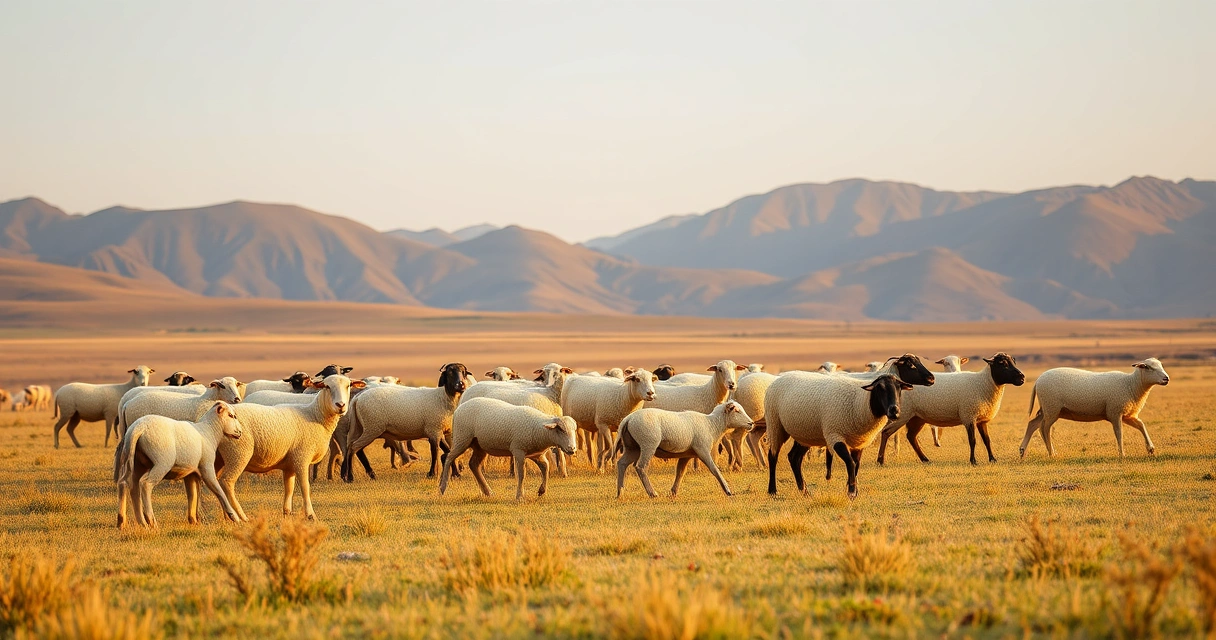
A 100-ewe sheep farm in Punjab returned Rs 4,42,320 net annual profit on Rs 25,71,860 income against Rs 21,29,540 running costs, in the Punjab Livestock and Dairy Development Department feasibility of 2020. Those rupee figures no longer hold.
Sheep farming (بھیڑ) in Pakistan runs on a departmental model published by the Directorate of Communication and Extension of the Livestock and Dairy Development Department, Punjab, Lahore in 2020, a companion volume to the goat feasibility of the same year. This page carries the sheep model in full: flock structure, mortality and lambing rates, shed dimensions, feed schedule, the complete fixed-cost table, the complete recurring-cost table and the complete income table. It then sets the 2020 prices against verified 2025 and 2026 prices, names the gaps, and compares the returns with the department’s calf fattening model.
What Is the 2020 Punjab Sheep Farming Feasibility?
The 2020 Punjab sheep feasibility is a costed commercial model for a flock of 100 ewes and 4 rams, published by the Directorate of Communication and Extension of the Livestock and Dairy Development Department, Punjab, Lahore. Its technical sources are the Directorate, the Directorate General of Sheep and Goat Development at Multan, the experimental livestock farms of Punjab, the University of Veterinary and Animal Sciences Lahore, the Agricultural University Faisalabad, and the institutions attached to the livestock department.
The booklet names 4 obstacles holding commercial sheep farming back in Pakistan: the absence of a marketing system, a shortage of training, a shortage of grazing ground, and a shortage of capital. It records that sheep are bought and sold without reference to breed, body weight, wool or milk yield, unlike crops whose support prices the government fixes each year, and identifies that as the reason returns stay below what the animals produce.
The sector context in the booklet put livestock at 55.91 percent of the agriculture sector and 11.80 percent of national income, with 13 percent of national exports. Those figures have since been restated. The Economic Survey 2025-26 puts livestock at 62.4 percent of agricultural value addition and 14.6 percent of GDP, inside a sector that the survey’s account of Pakistan as an agricultural country with facts and figures places at 23.4 percent of GDP and 33.1 percent of employment.
What Is the Flock Structure of the 100-Ewe Model?
The model runs 104 adult animals and produces 150 lambs a year. Adult mortality is 5 percent, the lambing rate is 1.5 lambs per ewe, and lamb mortality is 10 percent, leaving 135 lambs split into 68 males and 67 females.
| Parameter | 2020 model value |
|---|---|
| Breeding ewes | 100 |
| Rams | 4 |
| Total adult animals | 104 |
| Adult mortality at 5 percent | 5 animals |
| Lambing rate | 1.5 lambs per ewe |
| Total lambs per year | 150 |
| Lamb mortality at 10 percent | 15 lambs |
| Surviving lambs | 135 |
| Male lambs (چھترا) | 68 |
| Female lambs | 67 |
| Adult animals culled and sold each year | 25 |
| Adult animals carried into the next year | 79 |
Source: Punjab Livestock and Dairy Development Department sheep feasibility, 2020. The lambing rate of 1.5 is the main structural difference from the goat model, which uses 1.75, and it is why the sheep flock produces 150 lambs where the goat herd produces 175 from the same 100 breeding females.
What Does a 100-Ewe Sheep Farm Cost to Set Up?
Fixed cost in the 2020 model is Rs 42,96,000. Sheep are cheaper to buy than goats in this model, at Rs 15,000 a head against Rs 25,000, and they need less covered space, at 12 square feet against 15.
Animal purchase, 2020 model
| Item | Rate | 2020 cost |
|---|---|---|
| 100 young ewes | Rs 15,000 per animal | Rs 15,00,000 |
| 4 rams | Rs 20,000 per animal | Rs 80,000 |
| Total animal purchase | Rs 15,80,000 |
Construction of shed, office and store, 2020 model
| Item | Basis | 2020 cost |
|---|---|---|
| Housing for 104 adult animals | 12 sq ft per animal at Rs 600 per sq ft | Rs 7,48,800 |
| Boundary wall of that shed | 155 running feet, 4.5 feet high, at Rs 400 | Rs 2,79,000 |
| Housing for 150 lambs | 8 sq ft per animal at Rs 600 per sq ft | Rs 7,20,000 |
| Boundary wall of the lamb shed | 144 running feet, 4.5 feet high, at Rs 400 | Rs 2,59,200 |
| Store | Rs 1,000 per sq ft | Rs 1,44,000 |
| Office with bathroom | Rs 1,000 per sq ft | Rs 1,80,000 |
| Labour room with bathroom | Rs 1,000 per sq ft | Rs 1,80,000 |
| Total construction | Rs 25,11,000 |
The rate printed against the lamb shed wall in the scanned booklet is Rs 250 per running foot, but only Rs 400 reproduces both the printed line value of Rs 2,59,200 and the printed column total of Rs 25,11,000, so Rs 400 is the rate shown above.
Farm equipment, 2020 model
| Item | Quantity | Rate | 2020 cost |
|---|---|---|---|
| Chaff cutter | 1 | Rs 30,000 | Rs 30,000 |
| Water pump | 1 | Rs 20,000 | Rs 20,000 |
| Cart | 1 | Rs 15,000 | Rs 15,000 |
| Troughs | 2 | Rs 2,500 | Rs 5,000 |
| Wooden mangers (کھرلی) | 10 | Rs 4,000 | Rs 40,000 |
| Electricity connection | Rs 15,000 | ||
| Electrical fitting | Rs 30,000 | ||
| Miscellaneous items including tubs | Rs 50,000 | ||
| Total equipment | Rs 2,05,000 |
Adding the three blocks gives Rs 15,80,000 for animals, Rs 25,11,000 for construction and Rs 2,05,000 for equipment, a 2020 fixed cost of Rs 42,96,000.
What Are the Annual Running Costs of a Sheep Farm?
Recurring cost in the 2020 model is Rs 21,29,540 a year, with green fodder taking Rs 13,52,040 of it. Adults get 8 kg of green fodder a day, and lambs get 4 kg a day for the 8 months that follow 4 months on milk.
| Cost line | Basis in the booklet | 2020 cost |
|---|---|---|
| Green fodder (چارہ) for adults | 8 kg per animal per day at Rs 3 per kg | Rs 9,11,040 |
| Green fodder for young stock | 4 months on milk, then 4 kg per day at Rs 3 per kg | Rs 4,41,000 |
| Fodder sub-total | Rs 13,52,040 | |
| Concentrate (ونڈا) for adults | 0.5 kg per animal per day at Rs 20 per kg | Rs 93,600 |
| Concentrate for young stock | 0.5 kg per animal per day at Rs 20 per kg | Rs 2,02,500 |
| Wages of 2 workers | Rs 10,000 per month each | Rs 2,40,000 |
| Electricity | Rs 4,000 per month | Rs 48,000 |
| Medicine | Rs 150 per animal per year | Rs 26,850 |
| Depreciation on buildings | 5 percent a year | Rs 1,25,550 |
| Depreciation on equipment | 20 percent a year | Rs 41,000 |
| Sub-total | Rs 7,77,500 | |
| Total recurring cost | Rs 21,29,540 |
How Much Income Does a 100-Ewe Sheep Farm Produce?
Total income in the 2020 model is Rs 25,71,860, of which Rs 21,60,000 comes from selling lambs at Rs 16,000 a head. Culled adults add Rs 2,50,000, manure Rs 1,50,000, wool Rs 6,860 and skins Rs 5,000.
| Income line | Basis in the booklet | 2020 income |
|---|---|---|
| Sale of male lambs | 68 head at Rs 16,000 | Rs 10,88,000 |
| Sale of female lambs | 67 head at Rs 16,000 | Rs 10,72,000 |
| Sale of skins (کھال) | 20 skins at Rs 250 | Rs 5,000 |
| Wool (اون) from adults | Rs 20 per animal, twice a year, 104 animals | Rs 4,160 |
| Wool from young stock | Rs 20 per animal, once a year, 135 animals | Rs 2,700 |
| Manure (مینگنیاں) from adults | 2 kg per animal per day, 76 tons at Rs 1,500 per ton | Rs 1,14,000 |
| Manure from young stock | 1 kg per animal per day, 24 tons at Rs 1,500 per ton | Rs 36,000 |
| Sale of 25 culled adults | Rs 10,000 per animal | Rs 2,50,000 |
| Total annual income | Rs 25,71,860 | |
| Less total recurring cost | Rs 21,29,540 | |
| Net annual profit | Rs 4,42,320 |
The booklet adds 4 notes: 79 adult animals remain in place to continue the cycle, male animals should be sold at Eid ul Azha, animal prices can rise up to 10 percent as meat prices rise, and expenses can rise 5 to 10 percent with inflation. It also lists 81 sheep and goat markets across Rajanpur, Dera Ghazi Khan, Bahawalpur, Layyah, Mianwali, Vehari, Lodhran, Khanewal, Multan, Muzaffargarh, Khushab and Sargodha, each with its trading day.
Why Does Sheep Farming Show Lower Profit Than Goat Farming?
Sheep return Rs 4,42,320 against Rs 16,50,885 for goats in the same 2020 department models, a difference of Rs 12,08,565 from the same number of breeding females. Three variables produce almost all of it.
| Variable | Sheep model | Goat model |
|---|---|---|
| Breeding females | 100 | 100 |
| Birth rate | 1.5 | 1.75 |
| Surviving young per year | 135 | 157 |
| Sale price per young animal | Rs 16,000 | Rs 20,000 |
| Income from young stock | Rs 21,60,000 | Rs 31,40,000 |
| Milk income | none | Rs 4,05,000 |
| Wool income | Rs 6,860 | none |
| Fixed cost | Rs 42,96,000 | Rs 57,03,000 |
| Recurring cost | Rs 21,29,540 | Rs 22,57,015 |
| Net annual profit | Rs 4,42,320 | Rs 16,50,885 |
The lower lambing rate, the lower price per head and the absence of a milk line together cost the sheep flock Rs 13,85,000 of income, against savings of only Rs 14,07,000 in fixed cost and Rs 1,27,475 in annual running cost. Sheep also carry a wool line of Rs 6,860, which is small enough that it does not change the comparison. The sheep model is the lower-capital entry at Rs 42,96,000 against Rs 57,03,000, and the lower-return one.
How Do Sheep Returns Compare With Calf Fattening?
The department’s 2020 calf fattening feasibility runs 300 animals a year in 3 batches of 100, each held 120 days, and shows Rs 6,04,720 net profit per batch on Rs 30,96,800 of running cost. That model buys calves at 10 to 15 months old and about 100 kg at Rs 170 per kg live weight, targets 0.90 kg of daily gain over 120 days, and sells at 196 kg average at Rs 190 per kg, with 2 percent mortality.
Two contrasts matter for anyone choosing between the enterprises. Calf fattening turns capital over 3 times a year against once for a breeding flock, so its money is not tied up for a full breeding cycle. It also carries a much heavier fixed cost, Rs 95,88,000 in the 2020 model, of which Rs 60,00,000 is 10 acres of land at Rs 5,00,000 an acre, because the fattening model buys the land while the sheep model assumes it. Fattened animals also dress out at 52 percent against 48 percent for ordinary animals, which is the technical reason the fattening trade exists at all.
What Do These Sheep Numbers Look Like at 2026 Prices?
The 2020 rupee values cannot be carried forward. The rupee moved from roughly 160 to the US dollar in 2020 to roughly 279 in 2026, and feed, wages and construction all repriced separately from that. The table below sets each input against a verified current figure where one exists.
| Input or output | 2020 model figure | Verified 2025 or 2026 figure | Source and date |
|---|---|---|---|
| Breeding ewe purchase | Rs 15,000 per head | about Rs 1,000 per kg live weight for ordinary maindani sheep | BakDumGa sheep price guide, 2026 |
| Lamb at sale | Rs 16,000 per head | Qurbani sheep mostly Rs 85,000 to Rs 180,000 per head, budget crossbreds from Rs 55,000 | BakDumGa sheep price guide, 2026 |
| Mutton, retail | not in the model | Rs 1,918 per kg in July 2026, Rs 2,000 to Rs 2,400 per kg in May 2026 | Selina Wamucii July 2026; kfoods May 2026 |
| Farm wages | Rs 10,000 per month | Rs 40,000 per month legal minimum for unskilled workers | Punjab minimum wage notification, 8 September 2025 |
| Concentrate feed | Rs 20 per kg | Rs 3,110 to Rs 3,850 per bag, bag weight not stated by the source | Zaratnaama wanda rate list, April 2025 |
| Green fodder | Rs 3 per kg | gap, no current national rate verified | not verified |
| Shed construction | Rs 600 per sq ft | gap, no current rate for open livestock sheds verified | not verified |
| Sheep skin | Rs 250 each | gap | not verified |
| Wool | Rs 20 per clip | gap | not verified |
| Manure | Rs 1,500 per ton | gap | not verified |
The Qurbani prices in that table need reading with care. Eid ul Azha sheep prices reflect a seasonal ceremonial market and buyers paying for appearance and breed, not the commercial meat trade the feasibility describes, so they are the upper bound rather than the working assumption. The Rs 1,000 per kg live weight rate for ordinary village sheep is the closer comparison, and against it a 40 kg ewe costs about Rs 40,000 where the 2020 model paid Rs 15,000.
Green fodder is the gap that matters most, because it carries Rs 13,52,040 of a Rs 21,29,540 recurring cost. No verified 2026 per-kilogram green fodder rate was found, so it has been left unscaled. Applying an inflation multiplier to the largest line in the model would produce a figure that reads as researched and is not.
The structure remains sound. The 5 percent adult mortality, the 1.5 lambing rate, the 10 percent lamb mortality, the 8 kg of green fodder per adult per day, the 0.5 kg of concentrate, the 12 square feet of covered space and 24 square feet of open space per adult, and the 79 animals carried forward are planning inputs that outlive the prices attached to them.
What Housing and Selection Rules Does a Sheep Farm Follow?
The booklet allows 12 square feet of covered space and 24 square feet of open space per adult sheep, and specifies a shed 20 feet wide and 60 to 80 feet long for 100 animals, laid out east to west. Mangers are wooden, each 10 feet long, 6 inches wide at the base widening to 12 inches at the top, and 12 inches high. The shed floor sits at least 2 feet above the surrounding ground so rainwater drains away, and trees are planted around the shed to hold the temperature down.
Selection follows 3 rules. Buy healthy two-tooth ewes, preferably already pregnant. Buy from the district where the breed is established. Treat an animal as ready to breed once it reaches 66 percent of average adult body weight, because animals bought at that point return more than younger or older stock. Suitable sites are the rural districts of Punjab where grazing scrub is available and water supply and drainage can both be arranged.
Feeding rates, medicine rates and mortality assumptions on this page are those printed in the Punjab Livestock and Dairy Development Department sheep feasibility of 2020, with the calf fattening feasibility of the same year used for the comparison section. A veterinarian or the district office of the provincial livestock department should confirm current protocols before any of it is applied to live animals.
Key Takeaways on Sheep Farming Costs in Pakistan
- The 2020 Punjab feasibility models 100 ewes and 4 rams producing 150 lambs a year at a 1.5 lambing rate.
- Fixed cost in that model is Rs 42,96,000 and recurring cost is Rs 21,29,540 a year.
- Income of Rs 25,71,860 leaves Rs 4,42,320 net annual profit, at 2020 prices only.
- Sheep need 12 square feet of covered space against 15 for goats, and cost Rs 15,000 a head against Rs 25,000.
- Goat farming returned Rs 16,50,885 in the parallel 2020 model, and calf fattening Rs 6,04,720 per 120-day batch.
- Green fodder, shed construction, wool, skin and manure prices could not be verified for 2026 and have been left unscaled.
Frequently Asked Questions About Sheep Farming in Pakistan
How many lambs does one ewe produce per year?
The 2020 Punjab model uses a lambing rate of 1.5, so 100 ewes produce 150 lambs a year. After 10 percent lamb mortality, 135 survive, split into 68 males and 67 females.
How much space does one sheep need?
Each adult sheep needs 12 square feet of covered space and 24 square feet of open space. A shed for 100 animals is 20 feet wide and 60 to 80 feet long.
Is sheep farming more profitable than goat farming in Pakistan?
No. The 2020 Punjab models show Rs 4,42,320 net profit for 100 ewes against Rs 16,50,885 for 100 does, mainly because goats kid faster, sell higher and produce saleable milk.
How much fodder does one sheep eat per day?
An adult sheep eats 8 kg of green fodder and 0.5 kg of concentrate per day in the 2020 Punjab model. Lambs take 4 kg of green fodder after 4 months on milk.
What is the current price of a sheep in Pakistan?
Ordinary village sheep traded at about Rs 1,000 per kilogram of live weight in 2026. Qurbani animals sold mostly between Rs 85,000 and Rs 180,000 per head, which is a seasonal market.
Last Thoughts on Sheep Farming in Pakistan
Sheep farming in Pakistan is the lower-capital and lower-return member of the small ruminant pair. The 2020 Punjab feasibility puts Rs 42,96,000 into a flock of 104 animals against Rs 57,03,000 for the equivalent goat herd, and takes Rs 4,42,320 back against Rs 16,50,885. The gap traces to a slower lambing rate, a lower price per head and the absence of a milk line, none of which a farmer can change by managing better. What the model still supplies is a reliable skeleton: stocking density, feeding rates, mortality assumptions, culling ratios and the 79 animals that carry the flock into the next year. The prices bolted to that skeleton belong to 2020 and need replacing with local quotations before the profit line describes anything real.
